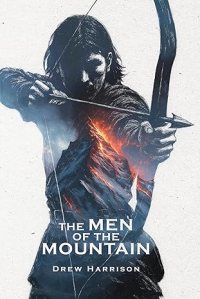
Synopsis:
Inscrutable and Ever-Watchful Masters
The Renn of Fort Hope place their faith in simple laws. They must trust the Dicta, those wise rules left by their forebearers; they must fear the savage Krieger, whose raids keep Renn walls perpetually splintered; and they must revere the Men of the Mountain, the magnanimous mystics who are stewards of their world.
For Cade, a clanless trapper, survival is a matter of following the rules. But when the Men of the Mountain took his sister—the only Renn ever chosen to return to their sacred peaks—Cade’s faith withers over five years of agonizing silence.
Now, a star has fallen from the sky, and its arrival threatens to spark an inferno. The Dicta are clear: all things from the sky belong to the Mountain. To hide its discovery is a death sentence… but its crater also houses a secret the Men of the Mountain would kill to protect. Forced to defy his gods alongside unlikely allies, Cade is drawn into a conflict where every secret he uncovers reveals a more terrifying lie at the heart of his world… everything is a cage, and the price of freedom is paid in blood and ash.
Favorite Lines:
“…guilt as heavy as mountains press me to silence, to inaction…”
“Forten’s eyes burn with hatred—hatred at the Men of the Mountain, at the Krieger, and presumably at himself for failing to save the woman he loved…but they settle on me last, and that hatred does not abate. Instead, it blooms like a bonfire tossed fresh firewood. Perhaps he hates me most of all…for bringing all of this down, for failing to protect any of them from any of it, for doing nothing while he stood firm against those who would defile her body.”
“Where music lives, void can not…fresh tears spill down my face at the remembrance. This special silence is no void…none could call this silence empty, as it reverberates with love, with pain, with admiration, with wonder, with loss.”
My Opinion:
I received a copy of this book from the author in exchange for my honest opinion.
The Men of the Mountain takes its time, and that patience is one of its greatest strengths. From the opening chapters, the book establishes a lived-in world where belief, labor, and survival are inseparable. Cade’s voice feels grounded immediately, shaped by routine, trade, and quiet loss. The writing lingers on the physical textures of his life — snow, hides, wood, hunger — not as decoration, but as the fabric of his reality. This is a story that understands how much meaning is carried in daily work, and how fragile that meaning becomes when power enters the picture.
What stood out to me most is how carefully the book handles authority. The Men of the Mountain are not introduced as distant myths or abstract forces. They arrive with ceremony, language, and expectation, and the imbalance of power is palpable long before violence ever appears on the page. Cade’s resentment and fear feel earned, not reactionary. His questions are quiet ones at first, rooted in absence, memory, and unanswered loss, and the book allows those questions to deepen slowly rather than rushing him toward rebellion.
The arrival of the fallen star is where the story shifts, but it never abandons its emotional center. What could have become spectacle instead becomes intimate and tense. Cade’s response is not heroic in the traditional sense. It is hesitant, conflicted, and deeply human. His sense of obligation competes with fear, curiosity, and grief, and the book never simplifies that internal struggle. The woman from the sky is not treated as a symbol or a prize, but as a destabilizing presence that forces Cade to confront the limits of the world he’s accepted.
By the end, The Men of the Mountain feels less like a story about overthrowing power and more like a meditation on what it costs to question it at all. The novel is interested in erosion rather than explosion — how belief wears thin, how obedience curdles into complicity, and how courage often looks like stubborn persistence rather than grand defiance. It’s a book that trusts atmosphere, interiority, and moral tension to do the heavy lifting, and that trust pays off.
Summary:
Overall, I found The Men of the Mountain to be a slow-burn, character-driven fantasy that prioritizes moral weight and worldbuilding over spectacle. It will appeal most to readers who enjoy literary fantasy, grim or grounded worldbuilding, and stories that examine power, belief, and resistance through ordinary lives. This is a novel for readers who value immersion, patience, and emotional consequence, and who don’t need their fantasy to shout in order to feel powerful. Happy reading!
Check out The Men of the Mountain here!
 Likely Story
2 thoughts on “Review: The Men of the Mountain by Drew Harrison”