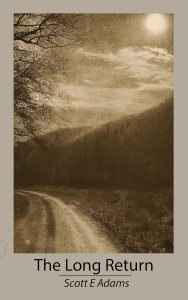
Synopsis:
In the forgotten logging town of Blowville, some memories refuse to stay buried.
Decades after the hemlock mills fell silent, Jonas Clarke has built a new life far from the shadows of Bailey Run. But when fate draws him back to the place he once called home, he returns as a man with only fragments of his past; haunted by a name, a feeling, and the sense that something in those woods still waits for him.
As Jonas begins to piece together the life he lost, he is pulled into the long-quiet mysteries that shaped Blowville’s darkest years: a troubled town, secrets sealed beneath the hollow tree, and the uneasy pact forged by the men who tried to bury the truth. With each revelation, Jonas uncovers not only the story of a town swallowed by its own history, but the part he played in it, and the price that was paid to keep its secrets hidden.
Book Three brings the saga to its final reckoning, bridging past and present as Blowville’s last unanswered questions rise to the surface.
Favorite Lines:
“He felt as though he had just clawed his way back from somewhere real.”
“You’re becoming yourself. Not whoever you were before, but who you choose to be now.”
“They aged together quietly, without hurry or drama. Their love did not flare; it glowed, steady as a coal ember in winter.”
My Opinion:
I received a copy of this book from the author in exchange for my honest opinion.
There’s something quietly unsettling about The Long Return, and I don’t mean that in a horror sense right away. It starts soft. Almost too soft. A boy wakes up with no memory, in a hospital, with nothing to hold onto except a single name—Clara—and a body that remembers more than his mind does. From the first few chapters, you can feel the story leaning into that slow, patient unraveling of identity. It doesn’t rush you. It lets you sit in the discomfort of not knowing.
What really surprised me is how much of the book isn’t about the mystery at all—at least not at first. Jonas builds an entire life in Altoona. He heals, he works, he marries Evelyn, he has children, and for a long stretch, the story almost convinces you that the past doesn’t matter. That maybe it shouldn’t matter. There’s something oddly comforting in those middle sections—like watching someone choose peace over truth. But underneath it, there’s always this quiet tension. The name Clara never fully goes away. The symbol, the dreams, the flashes of snow and water—they linger in the background like something waiting its turn.
And then the book shifts.
The later sections—especially once Jonas returns north—feel like a completely different layer of the same story peeling back. What I appreciated is that the payoff isn’t just “oh, here’s what happened.” It’s heavier than that. The truth isn’t just memory—it’s responsibility. When Jonas finally confronts the past at the clearing, it’s not just about remembering Clara—it’s about reliving it. The scene at the tree is one of the strongest in the book, because it collapses time completely. You’re not reading about what happened—you’re in it. The river, the attack, Clara calling his name—it all hits at once.
And Clara herself… I think this is where the book either works for you or it doesn’t. She isn’t just a lost love or a tragic figure. She becomes something more symbolic by the end—memory, guilt, unfinished truth, maybe even something tied to the land itself. When Jonas finally reunites with her—not as a memory, but as something real, something waiting—it’s less about romance and more about release. The ending leans into that almost spiritual, folklore-like tone where the valley remembers, where people become part of it. It’s not clean. It’s not overly explained. But it feels intentional.
If I had to sum up the experience, it’s a slow-burn story about choosing to forget—and what happens when the past refuses to stay buried. It’s quieter than most books in this space, but when it finally hits, it hits in a way that feels earned.
Summary:
Overall, The Long Return is a slow, atmospheric story that starts as a quiet “man rebuilding his life” narrative and gradually turns into something deeper and more haunting. The first half is grounded and almost comforting, but there’s always a subtle unease underneath. The second half pulls everything back to the past, revealing a heavier, more emotional truth that recontextualizes everything that came before. Not action-heavy, but very deliberate—best for readers who like slow reveals, emotional payoff, and a slightly eerie, almost folklore-like ending. Happy reading!
Check out The Long Return here!
 Likely Story
One thought on “Review: The Long Return by Scott E. Adams”