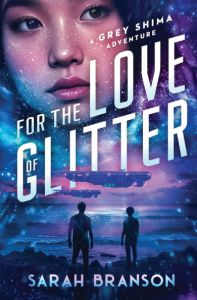
Review: For the Love of Glitter by Sarah Branson

Synopsis:

In Bosch, loyalty isn’t just earned—it’s tested. Grey Shima has her future all planned out: graduate, enlist, and follow in the footsteps of her fearless mother, Master Commander Kat Wallace. But when Grey meets the magnetic, passionate Edmund Sinclair, her world tilts. 

 He’s not just another boy with good hair and dangerous ideas—he’s a revolutionary, dead set on exposing the ugly truth behind the glittering power that fuels Bosch. Caught between love and legacy, Grey finds herself questioning everything: her training, her purpose, and her heart.

 But she’s not alone. Sy Mercer, Grey’s best friend, has stood by her side for years. Smart, steady, and secretly in love with her, Sy sees the danger Grey can’t—or won’t—acknowledge. As Grey spirals deeper into a movement that may not be what it seems, Sy must confront his own fears and decide how far he’s willing to go to protect her… even if it means losing her.

 Because love, like revolution, is rarely without sacrifice

In a postapocalyptic world rebuilding from ruin, For the Love of Glitter is a YA speculative romance about betrayal, resistance, and finding your true north-even when everything else is falling apart.

Favorite Lines:

“It was the month I stopped believing that everything would be okay and everyone would always be safe.”

“He took a deep inhale and smiled anyway, because some people were worth loving— even if they never looked back.”

“Checking myself in the mirror, I don’t see the girl who left home for her birthday. Nor the woman I though I’d become that night with Edmund either. I’m something in between. Sharper. Less trusting. Wiser.”

“I always had a hope. You, Grey Shima, are why I made it a plan.”

My Opinion:

I received a copy of this book from the author in exchange for my honest opinion. 

For the Love of Glitter is one of those YA novels that quietly disarms you before you realize how deeply it’s going to dig. It opens in the warmth of everyday life—board games, siblings, familiar teasing—but the comfort never feels accidental. Instead, it becomes the contrast that sharpens everything else. From the beginning, Branson establishes that Grey Shima’s world is one where safety is conditional and adulthood arrives early. Grey isn’t rebelling for the sake of noise; she’s reacting to knowledge she can’t unlearn. The book understands that once innocence cracks, it doesn’t shatter all at once—it splinters slowly, shaping how you move through everything that follows.

What makes the story especially compelling is how seamlessly the political and the personal are braided together. Glitter isn’t just a substance or an economic engine—it’s a moral inheritance. Grey’s frustration with adults who insist on nuance feels achingly real, especially when those adults are loving, competent, and still wrong. Her anger isn’t reckless; it’s focused. And that focus is mirrored and softened by Sy Mercer, whose quiet loyalty provides emotional ballast throughout the novel. Sy’s presence never competes with Grey’s voice, but it deepens it, giving the reader a constant reminder of what’s at stake emotionally when ideals collide with relationships.

The arrival of Edmund Sinclair complicates everything in exactly the way it should. He is charisma and ambition wrapped in righteous language, and Branson is careful not to make him a cartoon villain. Instead, Edmund represents the seductive pull of movements that promise clarity and purpose, even when they’re built on half-truths. Watching Grey fall under his spell is uncomfortable in the best way; the reader can see both the empowerment and the danger long before Grey does while feeling the emotional pain from Sy as he watches it all unfold.

By the time the story reaches its final chapters, For the Love of Glitter has matured alongside its protagonist shifting from a com-of age to reckoning.  The narrative widens, revealing that resistance doesn’t always look like refusal—it can also look like patience, planning, and legacy. The ending resists neat resolution, opting instead for something more honest: a future shaped by intention rather than certainty. It’s a conclusion that honors teenage idealism without pretending that change happens quickly or cleanly.

Summary:

Overall, For the Love of Glitter is a character-driven YA novel about activism, first love, and moral awakening in a world built on compromise. Through Grey Shima’s fierce voice, the book explores how systems harm, how movements seduce, and how growing up often means learning that change is slow—but still worth fighting for. Tender, politically sharp, and emotionally honest, this is a story that trusts its teenage characters with real complexity and trusts its readers to sit with it. Happy reading!

Check out For the Love of Glitter here!


Review: Dawn in Ruins by Magda Mizzi

Synopsis:

The world ended in silence. The fight for what’s left will not.

Ten months after the collapse, teenager Annie’s world has shattered, and with it, everything she once believed about monsters. They don’t always lurk in shadows. Sometimes they wear uniforms. Sometimes they wear the faces of those you love.

In the ruins of Sydney, Annie finds an unlikely ally in Jude—a half-infected boy marked by virus and twisted science. His strange, dangerous abilities make him both a threat and their best hope. But the line between abomination and saviour is thinner than either imagined.

Haunted by what was done to him, Jude carries scars deeper than flesh. Meanwhile, Annie’s younger brother, Lucas, remains a prisoner, infected and altered. If she doesn’t reach him soon, Lucas will face the same fate that nearly destroyed Jude—experiments that don’t just scar flesh but twist what it means to be human.

As secrets unravel and the origin of the virus comes to light, Jude learns a devastating truth: his connection to the outbreak is deeper, darker, and far more personal than he ever imagined.

Together, Annie and Jude race through a city where every shadow hides a threat. When they are torn apart, survival becomes more than a mission—it becomes a promise: to endure, to protect, and to bring each other back from whatever hell awaits.

From the shattered edges of the Fractured Reality universe comes a story of desperate hope and fierce loyalty—because in a world this ruined, some things are lost forever. But some are worth risking everything to save.

Favorite Lines:

“Before the world cracked, Annie believed monsters lived in stories. Now she knew better. They had names. Faces. Uniforms. Sometimes they looked like strangers with guns. Sometimes they looked like people you loved. Sometimes they were the ones you’d sworn to protect, until you couldn’t.”

“Maybe…but love is stubborn, isn’t it? It makes you brave, and foolish. I mean she was pretty determined to  have Othello —to keep him. She went against her father to be with him. That would have been pretty hard in those times. Shit, it’s still hard now. So, I guess she’s committed.”

“And they kept walking. Not towards certainty. But towards something. And, for now, that was enough.”

My Opinion:

I received a copy of this book from the author in exchange for my honest opinion.

Dawn in Ruins had me hooked from the first page. It’s dark, visceral, and unflinchingly human. Magda Mizzi takes a familiar apocalypse — a mutated virus, collapsing cities, soldiers with cold eyes — and turns it into something deeply personal. The story follows Annie, a teenage girl fighting to save her brother Lucas after the world has already burned, and Jude, a half-infected boy whose body is as much a mystery as his loyalty. From the first pages, the writing drags you into the heat, the grit, and the smell of a dying city. Every sentence feels alive and dangerous.

What I loved most is that this isn’t just another survival story. It’s about guilt and grief and that stubborn will to keep moving when everything is already broken. Annie isn’t your typical YA heroine — she’s angry, reckless, and full of contradictions. You can feel her pulse in every scene, from the blood and dust of Sydney’s ruins to the quiet moments when she can’t decide whether to hate or trust Jude. Mizzi captures that inner push and pull perfectly, the mix of fear and defiance that defines what it means to stay human when the world no longer is.

The relationship between Annie and Jude drives the novel. It’s tense and uncomfortable at times, but that’s what makes it work. Jude isn’t romanticized; he’s unsettling, strange, and sometimes frightening. Yet there’s a tenderness under the surface — a sense that both of them are clinging to whatever hope they have left. Their conversations carry the same weight as the action scenes, and the smallest touches or silences often say more than words.

There’s a cinematic quality to the writing — I would not be surprised to see this book hit the big screen in a few years. Mizzi’s Australia feels scorched and hollow, but also hauntingly beautiful. Every setting has a heartbeat, from the cracked roads to the eerie calm of the water. Dawn in Ruins is more than post-apocalyptic fiction. It’s a story about endurance, trauma, and the fragile connections that still matter when everything else has been stripped away. It leaves you raw but strangely hopeful.

Summary:

Overall, Dawn in Ruins is an emotional, post-apocalyptic survival story set in the ruins of Australia after a deadly viral mutation. Combining elements of science fiction, dystopian realism, and emotional character drama, it’s perfect for readers who love The Last of Us, Station Eleven, or The Girl With All the Gifts. It’s dark but heartfelt — a story for readers who like their survival tales human, messy, and deeply felt. Happy reading!

Check out Dawn in Ruins here!


Review: Blade Rider by Jaime A. Sevilla

Synopsis: 

In a future where stars map the last frontier and infinite space paves the road to dreams, Raven stands at the precipice of her world. In a vibrant, multi-species society filled with possibilities, she yearns to fly amongst the stars as an Air Ranger, an elite group of space pilots that navigate the cosmos and safeguard the world.

There’s only one catch: females aren’t allowed.

As Raven gets closer to her aspirations and learns what it takes to join them, she discovers lasting friendships,  new challenges, and what it ultimately means to be a ranger.

Can Raven push beyond the boundaries of societal norms and break through the stratosphere of glass ceilings, or will her star-filled quest for acceptance remain out of reach? Join her on this high-stakes,  interstellar ride and experience her exciting journey as she blazes her own path amongst the stars.

Based on the musical by Jaime A. Sevilla, “Blade Rider” spins an electrifying and poignant tale of courage, determination, and the relentless pursuit of dreams.

Favorite Lines:

“If you’re watching this and wondering what happened or what went wrong, I guess you could say this is all kinda my fault.”

“Wrapped in the velvet blanket of night, the world was asleep, even the shadows in slumber.”

“I don’t even think that’s a fair number. And how many of those were assists? You ever hear of Magic Johnson?”

My Opinion:

I received a copy of this book from the author in exchange for my honest opinion.

Blade Rider is equal parts sci-fi adventure and heart-driven coming-of-age story. It reads like a cinematic blend of Top Gun, Star Wars, and a Saturday-morning dream about flying. Sevilla clearly built this world first through music — you can feel the rhythm in the pacing — and the story keeps that pulse all the way through.

At its core, this isn’t just about high-speed flight; it’s about purpose. Raven Pierce is determined, stubborn, and constantly underestimated, but she carries the kind of optimism that sci-fi sometimes forgets to make room for. Her dream to become a Ranger isn’t just about glory — it’s about belonging, responsibility, and proving that belief and persistence matter more than permission.

The world of Blade Rider feels lived-in: diverse species, interplanetary alliances, and detailed flight tech that would make any space-opera fan grin. Yet what lingers is the emotion beneath it — the father-daughter moments, the camaraderie, the faith that one person can still make a difference. It’s big-hearted storytelling with old-school adventure energy.

Summary:

Blade Rider is perfect for readers who love hopeful science fiction, YA adventure, and music-infused storytelling. Think Ender’s Game if it had a soundtrack and a heroine who refuses to take no for an answer. Sevilla’s background as a composer gives the book a cinematic flow: every chapter feels scored.

For anyone who ever dreamed of flying — or just fighting for the chance to try — Blade Rider delivers that spark. Happy reading!

Check out Blade Rider here!