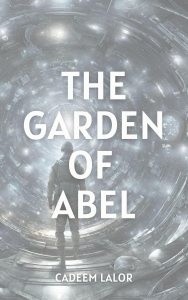
Synopsis:
Abel is in his thirties, divorced and feels stuck in his job as a high school teacher. When a version of himself visits from another dimension, he becomes the target of a fascist government.
Adam — the other version of Abel — was part of the team that developed a teleporter for accessing other dimensions. While the teleporter was meant to facilitate trade between planets, the government planned to use it to colonize less advanced worlds. Now Adam must flee a military that is eager to get its greatest weapon back.
Favorite Lines:
“Terrified, but fear’s kept us alive so far. It’s made us cautious, made us smart. I can embrace it without letting it cripple me.”
“Did you get that quote from a self-help book?”
“There were no good plans anymore; there were only ones that were slightly better than another.”
My Opinion:
I received a copy of this book from the author in exchange for my honest opinion.
The Garden of Abel starts with a quiet shock that never fully fades. The image of Abel confronting someone who looks almost exactly like him sets the tone for a novel that is less about spectacle and more about destabilization. What follows isn’t an action-heavy sci-fi story so much as a slow reckoning with what it means to be pulled into something much larger than yourself, whether you want to be or not.
What I appreciated most is how grounded the story feels, even with its interdimensional premise. The science is present, but it never overwhelms the human side of the story. Abel reacts the way a real person might: cautious, skeptical, curious, and increasingly uneasy. He doesn’t jump at the chance to be a hero, and he doesn’t fully trust what’s happening, even as the evidence stacks up. That hesitation makes his eventual involvement feel earned rather than convenient.
The relationship between Abel and his counterpart is where the book really finds its footing. Their conversations carry real weight and tension, not because they’re dramatic, but because they force uncomfortable questions into the open. The visiting Abel isn’t written as a clear villain, but he’s not absolved either. He’s complicated, burdened by guilt and justification in equal measure, and the book allows that messiness to exist without smoothing it out for the reader.
As the story builds toward confrontation, the tension feels personal rather than explosive. The stakes matter because of what they mean for Abel’s ordinary life, not just the fate of worlds. By the end, The Garden of Abel feels less like a story about alternate dimensions and more like one about unintended responsibility and moral fallout. It lingers because it asks you to think about what you would do when the consequences aren’t theoretical anymore.
Summary:
Overall, The Garden of Abel reads as thoughtful, restrained science fiction that values ethical tension over spectacle. If you enjoy sci-fi that focuses on choice, consequence, and quiet unease rather than nonstop action, this book will likely resonate. It’s the kind of story that unfolds slowly and stays with you after you’re done. Happy reading!
Check out The Garden of Abel here!
 Likely Story