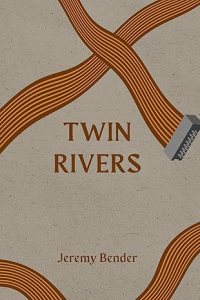
Twin Rivers by Jeremy Bender
I received a copy of this book from the author in exchange for my honest opinion.
Synopsis: The High Priest rules the city of Twin Rivers in the name of the Lord of Mercy, his AI god. In this land, where robotic Brothers complete all labor and humans are left to enjoy the fruits of this Eden, something rotten grows. Yonatan, a newly ascended Priest in the sclerotic Priesthood, is meant to shore up the faith of those left behind. Yet as Yonatan’s preaching takes him deep into the city’s bowels, he must confront heresy far deeper rooted than he ever imagined. When he sees one of the city’s paramilitary Keepers leave a young woman to die because of her unsanctioned implants, Yonatan must decide whether his faith in the Lord of Mercy outweighs his own belief in human exceptionalism.
Summary: Overall, Twin Rivers is a dense, unsettling dystopian sci-fi novel about a city that calls itself paradise while feeding on control, faith, and violence. Through priests, enforcers, and those left outside the walls, it explores how power hides behind ritual and how mercy becomes a weapon. Dark, intense, and uncomfortable in the right ways, it’s a story about what people are willing to ignore to keep believing they’re safe.
See the full review here: Twin Rivers
Purchase here
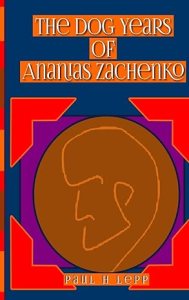
The Dog Years of Ananias Zachenko by Paul H. Lepp
I received a copy of this book from the author in exchange for my honest opinion.
Synopsis: What do you do when you run out of time? Ask Ananias Ezra Zachenko what he did after he was diagnosed. He set an agenda, took care of finances, delved into relationships, considered the heroic act. Didn’t go into denial, but defiance, there’s a difference.
He put it all in motion during the time he had left. A dog gets seven years to our one. Chenko rationalized the relationship by taking the best from both, our days the dog’s years and began to calculate. Anything to lengthen the short leash he is on.
During his dog years he planned for everything, but nothing turned out as expected. He concentrated on time, when he should have been looking at weight. No matter the type of year, when one runs out of time on this side, one has to figure out how to make weight on the other side.
Summary: Overall, The Dog Years of Ananias Zachenko is a quiet, thoughtful novel about illness, time, and the way diagnosis forces a person to renegotiate their relationship with living. Grounded, reflective, and emotionally restrained, this story explores how we measure time when the future becomes uncertain — and whether time can ever really be controlled at all.
See the full review here: The Dog Years of Ananias Zachenko
Purchase here

Her Ravishing Heartless Prince by A P Von K’Ory
I received a copy of this book from the author in exchange for my honest opinion.
Synopsis: He’s a European prince with a thousand-year lineage—and he hates her as much as he craves her.
Alyssa:
Prince Carl-Theodor Frederick Maximillian Christoph Albert Maria Johann Anselm is as insufferable as his name is long. Arrogant, powerful, entitled—everything I despise wrapped in devastatingly gorgeous packaging.
So I do what I do best: verbally eviscerate him and his precious bloodline with razor-sharp insults. I avoid him like the plague.
But avoidance only delays the inevitable.
Soon he has me exactly where I’ve been secretly fantasizing—on my knees before him. The problem? I can’t tell if this is seduction or revenge. Prince Hot and Cold swings between arctic ice and molten lava, dragging me to the edge of beautiful insanity.
The real question: will I survive the fall?
Prince Carl-Theodor:
Alyssa obliterates my world like a derailed train the moment we meet. Her beauty blinds me—then her vicious tongue insults thirteen thousand years of noble bloodline.
No one has ever dared.
As Head and Defender of the House of Saxony-Bremer, I vow on my ancestors’ graves to make her pay. I’ll bend her. Break her. Make her beg until she drowns in regret.
But here’s the twisted irony that threatens everything: hurting her destroys me too.
I can watch her crumble, hear her wounded cries—but the moment she surrenders, something in my chest stops cold.
Have I sworn an oath that will damn us both? And why does her pain feel like my own destruction?
Summary: Overall, this is a high-drama, ego-heavy royal romance where attraction and revenge walk hand in hand. If you enjoy dominant alpha tension, pride-fueled misunderstandings, and romance wrapped in luxury and lineage, this delivers an intense, indulgent ride.
See the full review here: Her Ravishing Heartless Prince
Purchase here

The 7 Albums of Stovepipe by Paul H. Lepp
I received a copy of this book from the author in exchange for my honest opinion.
Synopsis: From 1948 to 1982 nothing was as high mileage as a turntable. The speed limit was set at 331/3 rpms to take a spin down a highway of tunes on a ten-inch vinyl LP (Long Play) record album. The turning point 1982 when Compact Discs began to put the albums in our attics and closets. To some the change from LP to CD was a turning point on the same level as BC to AD. A wealthy collector has a well-trained staff they spend their time on finding the artifacts the turning points of the Boomer Generation left behind, items like Lee Harvey Oswalt’s belt, Jack Ruby’s cuff links. His staff comes across a nine word offer on the net, “Any Albums Made by the Stovepipe – Name Your Price.” He allows his staff to investigate, the project becomes an obsession. What they find out is a group known as The Chronologists are also interested in the authenticity of Stovepipe, the Musical Massiah between LP and CD, master of voice and instrument, lord of technology. Both Collector and Chronologists want to prove Stovepipe beyond a myth like Paul Bunyan or Johnny Appleseed, but for different reasons. One wants to prove he is alive, the other dead, and only one can be right.
Summary: Overall, a dense, unconventional novel that blends conspiracy, cultural history, and myth-making, The Seven Albums of Stovepipe is less about proving whether its central figure exists and more about why we need him to. The book rewards patient readers who enjoy experimental fiction, unreliable narrators, and stories that feel part oral history, part conspiracy file — especially those interested in music culture and how influence gets erased or mythologized.
See the full review here: The 7 Albums of Stovepipe
Purchase here
 Likely Story