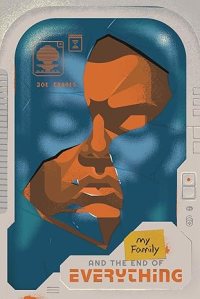
Synopsis:
The end of everything begins closer than you think. Of course, it always includes such foul practices as bureaucratic corruption, disregard for science (or the overindulgence of it), and corrupted religion. But this is not where it starts. It begins much closer to home-smart homes to be exact, and well-intentioned inventions (they really did think it was a good idea)-and human consolidation, and old men doing their best to retire.
My Family and the End of Everything follows generations of the Profeta family as they march naively towards the setting sun. The ending doesn’t come with explosions-at least, not at first. It arrives quietly, in funerals, final meditations, historical preservation, and decisions no one remembers volunteering for. From networked houses and autonomous bots to terraformed worlds, time travel, dying suns, and suspiciously ceremonial banquets, these stories track humanity’s ongoing attempt to stay human, in all our gloriously human ways.
This isn’t one apocalypse, but several, for the world ends far more often than we’d like to admit. Yet somehow, through all of them, a family-and their stubborn faith in each other and in their God-finds a way to endure and present to us this question: If we could change the future, would we?
Favorite Lines:
As I do with all of my short story collection reviews, rather than favorite lines, here are a few of my favorite stories: The House, The Pivot, and The Day the Sun Died.
My Opinion:
I received a copy of this book from the author in exchange for my honest opinion.
This is one of those books that feels quiet while you’re reading it — and then very loud in your head afterward. I went in expecting a more traditional sci-fi dystopia: smart homes, neural implants, generational timelines, the sun literally going dark. And yes, all of that is here. But what surprised me most is how personal it feels. The novel is structured as a collection of short stories that tell family histories. Each story stands on its own, with its own setting, tone, and central character, but they’re stitched together by bloodlines, history, and a shared looming reality: the slow unraveling of humanity under the weight of technology, time, and its own ambition.
The early stories, like The House and The Water That Shapes Us, are intimate and unsettling. They explore smart homes that optimize autonomy away and villages wrestling with the moral cost of hyperconnection. But those are just the opening notes. As the book unfolds, we move into space brokers and gravity trials, time-traveling historians chasing the elusive “Pivot,” off-world settlements, generational missions, political maneuvering, and ultimately the literal death of the sun. Each short story feels like a snapshot from a different era of the same extended family — different centuries, different planets, different moral dilemmas — but all orbiting the same core questions: What shapes us? What do we inherit? What do we sacrifice to survive?
Because it’s structured as a collection, the pacing feels episodic. Some stories hit harder emotionally, some lean more philosophical, and others feel almost like thought experiments wrapped in narrative. That variety is part of the experience. You’re not meant to sink into one continuous arc; you’re meant to see evolution over time — spiritual, technological, familial. The repetition of certain themes across generations (connection vs. isolation, faith vs. efficiency, autonomy vs. optimization) is deliberate. It builds a cumulative weight rather than a single crescendo.
What makes the format work is the throughline of family. Even when the timeline jumps or the setting shifts from Earth to orbit to distant systems, you feel the continuity. The book reads like an archive passed down through centuries, asking whether progress always equals improvement. It’s ambitious in scope — far bigger than just one storyline — and that ambition is both its strength and its defining characteristic. If you go in expecting one protagonist and one conflict, you might feel untethered. But if you lean into the anthology-style structure, the mosaic effect becomes the point.
This collection is less about the end of the world and more about the slow rewriting of what it means to be human.
Summary:
Overall, I found this book to be a reflective, generational sci-fi that explores what we lose when everything becomes connected. Instead of flashy dystopia, this book offers quiet, unsettling plausibility — smart homes that optimize away autonomy, neural networks that gently suppress prayer, and families wrestling with what shapes identity across centuries. It’s thoughtful, faith-tinged, and morally gray in the best way. If you like speculative fiction that prioritizes emotional and philosophical depth over action, this one lingers. Happy reading!
Check out My Family and the End of Everything here!
 Likely Story