The Boy with the Thorn in His Side by L.J. Robson
I received a copy of this book from the author in exchange for my honest opinion.
Synopsis: For most of my life, I felt like something was wrong – like I was living with a shadow I couldn’t see, a weight I couldn’t name. My childhood was marked by fear, confusion, and memories that never quite fit together. I knew there were pieces missing, but I never expected the truth to be more terrifying than my worst nightmares.
This is my story. A journey through trauma, survival, and the battle to reclaim my own mind. It’s about the ghosts of the past that never stopped whispering, the questions no one wanted to answer, and the slow unravelling of a reality I had been forced to forget.
Told with raw honesty, The Boy with the Thorn in His Side is not just an account of what happened to me – it’s a testament to resilience, a fight for acceptance, and a message to anyone who has ever felt trapped by their own past.
Sometimes, the truth is the hardest thing to face. But in facing it, we find the strength to break free.
Summary: Overall, The Boy with the Thorn in His Side is a raw, unfiltered memoir of trauma, resilience, and healing. L. J. Robson takes you into the shadows of his childhood home, unafraid to expose the scars of abuse and the chaos of survival. It’s heavy, often heartbreaking, but threaded with moments of hope and honesty. A difficult yet rewarding read.
See the full review here: The Boy with the Thorn in His Side
Purchase here
The Hidden Life by Robert Castle
I received a copy of this book from the author in exchange for my honest opinion.
Synopsis: The police have just surrounded the hereditary mansion of Gladwynne Biddleton. He has just shot and wounded his security chief, Dominic Kittredge, and killed Dominic’s wife, Theresa. As he watches the siege unfold on TV, historical visions besiege Gladwynne’s mind. By turns he is a B-17 bombardier; an SS officer tasked with burning the bodies of Adolf Hitler and Eva Braun; a fugitive pursued by the celebrated Nazi hunter, Simon Wiesenthal; and a co-conspirator in the assassination of Austrian Archduke Franz Ferdinand and his wife, Sophie, Duchess of Hohenberg.
Between the television coverage and the pageant in his head, Gladwynne becomes dissociated from what has just actually happened. Fixation on his immediate physical needs and with life in the mansion tend to conceal the enormity of his crime from him. He descends into a narrowing and harrowing spiral of isolation.
Why did he shoot his closest confidant, Dominic? We don’t quite know. But in Dominic’s thirty year diary of serving Gladwynne we begin to find clues. In this chronicle, Dominic recounts the “golden age” of their association, a time when the two men devised a mock nation with Gladwynne as its center. With Dominic’s encouragement, Gladwynne came gradually to conceive of his own physical person as a sovereign state, competing diplomatically with other world states, persistently resisting their efforts to deprive him of his sovereignty. Between the hostile international powers out to get him and the police now at his door, will Gladwynne’s confusion become total?
Summary: Overall, Robert Castle’s The Hidden Life is a dark, ambitious novel that intertwines wealth, madness, and loyalty into a portrait of a man unraveling. Both unsettling and absorbing, it’s a story that lingers long after the final page, not just for what it says about one family, but for what it suggests about the hidden lives we all construct.
See the full review here: The Hidden Life
Purchase here
Settle Down by Ritt Deitz
I received a copy of this book from the author in exchange for my honest opinion.
Synopsis: A college kid endowed with hypnotic powers keeps telling himself there’s got to be more waiting for him after graduation than family in the neighborhood and an okay catering job. Maybe he just needs to get his story straight.
Kenny McLuher is far from his native Wisconsin, in his last year at the University of Virginia, majoring in history with no idea what he’s going to do with it. At his catering job, Kenny’s old Southern folktales keep putting his co-workers to sleep, and in Kenny’s dreams President Abraham Lincoln sure seems to be trying to tell him something.
Maybe the pieces will come back together after graduation when Kenny returns to Madison, where he can ask the big question: What is home, anyway?
Summary: Overall, Settle Down is a warm, heartfelt coming-of-age tale about finding home in unexpected places. It’s a quietly triumphant debut that will resonate with anyone who’s ever wondered where they truly belong.
See the full review here: Settle Down
Purchase here
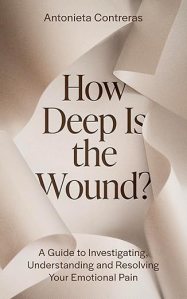
How Deep is the Wound by Antonieta Contreras
I received a copy of this book from the author in exchange for my honest opinion.
Synopsis: Finally, a Clear Path Through the Confusion of Modern Trauma Language
If you’ve ever wondered whether your struggles “count” as trauma, felt overwhelmed by conflicting mental health advice, or questioned why some healing approaches work for others but not for you—this book offers the clarity you’ve been seeking. Today’s mental health conversations have reduced the rich complexity of human suffering into a single box labeled “trauma,” used for both devastating life-altering experiences and everyday disappointments—a confusion that serves no one well. This tendency leaves people either minimizing genuine injuries or pathologizing normal life challenges.
Antonieta Contreras introduces an approach that distinguishes different types of psychological wounds based on their actual depth and impact on your nervous system. Drawing from years of clinical practice, extensive research, and personal recovery, she provides the missing understanding to accurately assess your experiences and match them with effective strategies.
You’ll discover the differences between:
- Emotional Pain: Hurts that sting but don’t fundamentally alter your system
- Emotional Wounds: Deeper impacts that linger after the initial hurt
- Traumatization: The active process of seeking safety
- Trauma: Deep injuries that rewire how you perceive the world
Learn why using a hammer for surgery or a scalpel for construction both create problems—and how matching your healing approach to your actual wound depth accelerates recovery while preventing unnecessary suffering.
Discover how to honor your pain without being defined by it, moving from identity-based labels toward agency-focused growth that reclaims your power to heal and thrive. This book examines how your unique nervous system responds to overwhelm.
Real-World Applications
- Assess childhood experiences accurately without minimizing or catastrophizing
- Recognize trauma bonding and attachment wounds that keep you from living fully
- Understand why some relationships feel impossible to leave
- Navigate narcissistic abuse and emotional manipulation
- Distinguish between healthy processing and rumination that reinforces pain
- Build genuine resilience based on nervous system regulation
This book is for:
- Anyone confused about whether their experiences constitute “trauma”
- People who’ve tried multiple healing approaches without lasting results
- Individuals stuck in cycles of pain, insecurity, lack of motivation or satisfaction, or relationship difficulties
- Those seeking to understand childhood experiences and their adult impact
- Anyone wanting to move beyond victim identity toward empowered recovery
- Mental health professionals seeking more nuanced assessment tools and practical exercises for their clients
When you understand the actual depth of your wounds, you can choose interventions that match their severity. This prevents both under-treatment that leaves you unresolved and over-treatment that creates unnecessary pathology. You will spend less time on ineffective approaches and focus your energy on strategies that are effective for your specific situation.
This book avoids both toxic positivity and victim mentality, acknowledging real suffering while emphasizing human capacity for growth and adaptation. Learn to work with your nervous system’s intelligence rather than against it. You’ll finish with practical tools for regulation, boundaries, and building the safety your system needs to thrive.
Stop wondering if your pain is “enough” to deserve attention. Learn to honor your experiences and discover what it means to finally feel yourself again. Transform your relationship with your own story and step into the clarity, agency, and hope that effective healing provides.
Summary: Overall, Antonieta Contreras’s How Deep is the Wound? blends clinical expertise with accessible storytelling to help readers understand the spectrum of emotional pain—ranging from everyday struggles to deep trauma—and argues that distinguishing between them is key to healing. By challenging the overuse of trauma language while offering practical exercises and compassionate guidance, Contreras reframes pain as a sign of our innate adaptability rather than evidence of brokenness, ultimately encouraging readers to approach their wounds with clarity, agency, and hope.
See the full review here: How Deep is the Wound?
Purchase here


 Likely Story