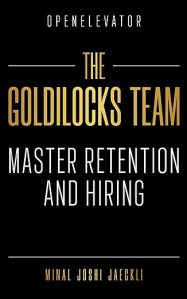
Synopsis:
We all have a universal desire to work with great people, but they can be hard to find and even harder to keep for the long-term. Leaders facing disengaged employees, high turnover rates, and fierce competition for skilled professionals, know too well that the cost of losing talent goes beyond financial impacts, it disrupts your organization, stunts innovation and undermines your competitive position.
In The Goldilocks Team: Master Retention and Hiring, you’ll take an illuminating and entertaining deep dive into the core drivers of employee engagement, the evolution of workplace culture, values alignment, and interpersonal alignment, and learn how to:
• Address the root causes of turnover and improve retention
• Implement practical, immediately actionable tactics to engage your team
• Align your organization’s retention strategies with employee values for lasting success
• Build high-performing teams that deliver for the long-term, without guesswork
Whether you’re a seasoned business leader or a new manager, this provides a clear roadmap to keep your existing team members engaged for the long-term and to successfully hire top talent that is positioned to thrive within your organization.
Ready to build a team that’s high-performing, fully engaged and loyal? This book will show you how.
Favorite Lines:
“Engaged employees lead to happy customers, which leads to a thriving business. It’s a win-win-win!”
“You know you can pay people to do things, but you can’t pay people to care. Engaged employees care.”
My Opinion:
I received a copy of this book from the author in exchange for my honest opinion.
In The Goldilocks Team, Minal Joshi Jaeckli delivers a refreshingly insightful and practical framework for building highly engaged, high-performing teams in a time when traditional hiring practices are breaking down. Through sharp storytelling, strategic thinking, and deeply personal experience, she challenges business leaders to rethink everything they know about employee engagement.
The book is built on the foundational idea that the perfect team isn’t formed by hiring the smartest, fastest, or most accomplished people—it’s about creating the “just right” combination of traits, values, and interpersonal dynamics. This Goldilocks approach—drawing from the classic tale where things must not be too extreme but just right—serves as both a metaphor and a methodology for curating teams that can thrive sustainably.
Jaeckli distills decades of experience across global industries—from pharmaceuticals to tech—to argue that disengagement is not simply a talent issue; it’s a leadership one. She outlines four critical engagement drivers: safety & certainty, contribution & purpose, growth & significance, and connection & belonging. By addressing these pillars thoughtfully, leaders can turn unmotivated employees into mission-driven contributors.
The writing style is candid and witty, laced with clever analogies (Cinderella hiring, diffused culture, stale shipwrecks), making even complex topics approachable. Jaeckli doesn’t shy away from naming what’s broken—outdated job descriptions, misaligned onboarding, superficial perks—and offers concrete suggestions for building real alignment between individual motivation and organizational goals.
One of the book’s most powerful ideas is the call to flip hiring and retention on their heads. Instead of finding “right” people, we should focus on forming the “right fit.” Instead of throwing perks at disengagement, we need to listen, build trust, and understand what people truly want in a workplace.
Summary:
Overall, The Goldilocks Team is more than a leadership guide—it’s a manifesto for how the modern workplace needs to evolve. Minal Joshi Jaeckli doesn’t just talk about fixing disengagement; she offers a human-first framework to build teams that actually work. This book will resonate with anyone who has ever led a team, struggled to keep talent, or wondered why traditional hiring just isn’t cutting it anymore. Insightful, smart, and surprisingly entertaining, this is a must-read for leaders ready to build organizations where people feel purpose, not just pressure.
Check out The Goldilocks Team here!
 Likely Story