Review: The Amalfi Secret by Dean and Catherine Reineking

Synopsis:

When Gabe Roslo arrives in Amalfi, Italy, a long-awaited reunion with his grandparents takes a tragic turn. His beloved grandfather is dead—and a cryptic diary left behind is Gabe’s only clue to the mystery surrounding his sudden death. But what starts as a personal tragedy quickly spirals into a high-stakes international puzzle.

Teaming up with Anna, a resourceful Roman local, Gabe follows a trail of hidden truths that stretches from the stunning Amalfi coast to the corridors of global power. Secret codes, powerful enemies, and a legacy of deception pull them into a world where nothing is as it seems. With each twist, they are forced to question their allies and uncover dark secrets that could shift the global balance of power.

But as the walls close in, Gabe and Anna must risk everything to expose the truth before it’s buried forever. Will they decipher the mystery and reveal the sinister forces at play? Or will they become the next victims of The Amalfi Secret?
Perfect for fans of Dan Brown and Robert Ludlum, The Amalfi Secret is a pulse-pounding thriller that will keep you guessing until the final, breathtaking twist.

Favorite Lines:

“She was slight of stature and frail to look at, but he knew from experience that she had an inner strength that would get her through almost any trial.”

“The Italians sure have style. Only  here would someone wear black leather driving gloves.”

“We Italians are more concerned with beauty than perfection.”

My Opinion:

I received a copy of this book from the author in exchange for my honest opinion.

The Amalfi Secret is the kind of thriller that sneaks up on you. It starts quietly, almost cinematically, and before you realize it, you’ve been swept into a world of prophecies, politics, and secrets buried deep in the marble corridors of history. The story moves between the present and the past with a rhythm that feels effortless, and even when the stakes climb, the authors manage to keep the human element right where it belongs—at the center. What surprised me most wasn’t the espionage or the religious intrigue, but the emotion underneath it all. It’s a story about love, legacy, and how far people will go to protect the truth.

There’s a gravity to the writing that reminds me of old-school political thrillers, but with more heart. Gabe Roslo is not your typical hero; he’s quietly capable, haunted, and deeply loyal. His grief feels genuine, and his need for answers pulls you along as much as the mystery itself. The story’s backdrop—the cliffs of Amalfi, the solemn air of Rome, the shadowed corners of the Vatican—adds an atmospheric beauty to the unfolding tension. You can almost smell the sea salt and espresso as danger closes in.

I also appreciated that the authors didn’t rush the reveal. They take their time, letting secrets drip out through journal entries, coded mirrors, and the wary exchanges between friends who might not be what they seem. Every conversation feels loaded, every clue slightly out of reach. The pacing builds slowly but deliberately. And just when you think you understand the scope of the story, it widens again—to global conspiracies, ancient orders, and moral choices that test faith and loyalty.

This isn’t just a novel about espionage or religion—it’s about the spaces between them. About belief turned dangerous, power wrapped in prophecy, and how history never stays buried for long. It’s a slow burn that rewards patience and curiosity, a blend of The Da Vinci Code’s intrigue with All the Light We Cannot See’s emotional depth. If you like stories that balance intellect with heart, this one lingers after you close the book.

Summary:

Overall, The Amalfi Secret is a richly layered political and historical thriller that blends mystery, faith, and love against a vivid European backdrop. It’s ideal for readers who enjoy intelligent thrillers, religious or historical mysteries, dual-timeline narratives, and character-driven suspense. Happy reading!

Check out The Amalfi Secret here!


Monthly Features – October 2025

Hummingbird Moonrise by Sherri L. Dodd

I received a copy of this book from the author in exchange for my honest opinion.

Synopsis: The past two years have taken their toll on Arista Kelly. Once an eternal optimist, now she has faced the darkness and must recalibrate what true happiness means for her. Meanwhile, Shane, her ex-boyfriend, is pulling all the right moves to help keep her sane from her heightening paranoia. But it doesn’t help that Iris, her Great Aunt Bethie’s friend, has disappeared.

Still, one additional trial remains. While searching for Iris, Bethie and Arista stumble upon a grand revelation in the eccentric woman’s home. With the discovery, they realize their run of chaos and loss of kin may have roots in a curse that dates back to the 1940s—the time when their family patriarch first built Arista’s cottage in the redwoods and crafted his insightful Ouija table.

This pursuit will not follow their accustomed recipe of adrenalized action, but the high stakes remain. Will the mysterious slow burn of unfolding events finally level Arista’s entire world or be fully extinguished, once and for all?

Summary: Overall, Hummingbird Moonrise is a paranormal mystery that works because it never loses its human touch. Yes, there are curses, possessions, and supernatural forces, but there’s also cinnamon bread, inside jokes, and the kind of family loyalty that keeps people moving forward even when the odds feel impossible. What I admired most is the way Dodd lets the suspense simmer without sacrificing warmth. The book left me both unsettled and comforted—a rare combination that lingers long after the last page

See the full review here: Hummingbird Moonrise
Purchase here


Unborn by Eva Barber

I received a copy of this book from the author in exchange for my honest opinion.

Synopsis: Olesya was not born like other people but was found in the Siberian Forest by a couple unable to have children. Plagued by mysterious visions and dreams, she struggles to fit into a society both as a socially inept but brilliant child and as she becomes part of a research team to discover the nature of dark matter. The findings of this discovery never make it to the scientific community as the project leader goes missing and the physics lab blows up, destroyed by a powerful foe with seemingly noble intentions.

Seattle detectives question Olesya in connection with the explosion and the disappearance of her boss. She becomes a person of interest until she herself goes missing. From her kidnappers, she learns that her parents, knowing she lacked a belly button, suspected she was created by the Russian government as part of a scientific experiment, and emigrated to the USA to hide and protect her. She also learns she possesses powers related to dark matter and of the existence of a brother held captive since his discovery by the Russian government. Even though she suspects her kidnappers’ interest in her and their motivations aren’t so noble, she joins them in rescuing her brother. Catastrophic world events following the successful rescue force her to continue working with her foes to save the world from destruction.

While working to save the world, Olesya experiences a moral dilemma and becomes someone she never thought she’d be—a mother. Olesya learns of mysterious chambers scattered around the world, and her visions return to haunt her, until she opens the chambers and learns their secrets, wishing she hadn’t. Now she faces the heart-wrenching realization that she must travel into a dark dimension to save the world from self-destruction. Worse yet, her daughter, Emery, is the key to humanity’s salvation and must follow her mother once she becomes an adult because she is the only being who can travel where no one else can to restore balance to the universe and return with an extraordinary gift for humanity. But powerful entities have reasons to keep the gift away from humanity and will do anything to stop her.

Summary: Overall, Unborn is a haunting, beautiful story about science, motherhood, and the unknowable threads that connect us. It’s the kind of book that lingers quietly after you’ve finished it — the kind that leaves you wondering whether what you just read was speculative fiction or something closer to a modern myth.

If you like stories that mix atmosphere and emotion — think The Time Traveler’s WifeNever Let Me Go, or The Daughter of Doctor Moreau — you’ll find something to love here. It’s for readers who enjoy a story that makes you think and feel at the same time; readers who don’t mind when mystery lingers even after the answers come. 

See the full review here: Unborn
Purchase here


Smoke on the Wind by Syvila Weatherford

I received a copy of this book from the author in exchange for my honest opinion.

Synopsis: “Smoke on the Wind” is a captivating tale that weaves the perils and dangers encountered on the Western frontier by Will Lawton, a young Black cowboy, after kidnapping then wedding his young Native American bride, Niabi. He plods a path packed with uncertainty that ultimately winds its way to an unthinkable opportunity – a race for free land.

Follow the characters of Smoke: the beautiful Louisa Ortega, who haunts the memory of the Chief’s son, Nashoba; Captain Horton, head of Fort Townsend, charged with keeping peace between settlers and tribes, and Dakota Sam, a rambunctious Civil War veteran attached to his military blues and backwoodsman ways.

This is the second book in an epic series, following the success of Weatherford’s first novel, “Blessings from the Four Winds.”

In this sequel, new characters are introduced: Liao Ming Chow, a Chinese immigrant, Sargent Thomas of the Buffalo Soldiers, and Mr. Todd Morgan the railroad tycoon. Niabi and Will raise two children and enjoy the protective company of their horses: Rodeo and FireTip. Their journey is marked by resilience, the spirit of community, and the ongoing struggle for safety and belonging.

Summary: Overall, Smoke on the Wind is a vivid continuation of America’s untold stories — where race, heritage, and faith collide. It’s tender and unflinching, full of voices that feel like they’ve been waiting a century to be heard. Weatherford writes history the way it deserves to be written: not as distant fact, but as living memory. For readers who are drawn to immersive, historical fiction.

See the full review here: Smoke on the Wind
Purchase here


Review: Smoke on the Wind by Syvila Weatherford

Synopsis:

“Smoke on the Wind” is a captivating tale that weaves the perils and dangers encountered on the Western frontier by Will Lawton, a young Black cowboy, after kidnapping then wedding his young Native American bride, Niabi. He plods a path packed with uncertainty that ultimately winds its way to an unthinkable opportunity – a race for free land.

Follow the characters of Smoke: the beautiful Louisa Ortega, who haunts the memory of the Chief’s son, Nashoba; Captain Horton, head of Fort Townsend, charged with keeping peace between settlers and tribes, and Dakota Sam, a rambunctious Civil War veteran attached to his military blues and backwoodsman ways.

This is the second book in an epic series, following the success of Weatherford’s first novel, “Blessings from the Four Winds.”

In this sequel, new characters are introduced: Liao Ming Chow, a Chinese immigrant, Sargent Thomas of the Buffalo Soldiers, and Mr. Todd Morgan the railroad tycoon. Niabi and Will raise two children and enjoy the protective company of their horses: Rodeo and FireTip. Their journey is marked by resilience, the spirit of community, and the ongoing struggle for safety and belonging.

Favorite Lines:

“For these groups, opportunities do not arise so easily; they are as elusive as smoke on the wind.”

My Opinion:

I received a copy of this book from the author in exchange for my honest opinion.

Set in the Reconstruction-era South, Weatherford’s novel continues the story begun in Blessings from the Four Winds, but stands firmly on its own as a sweeping, character-driven story about freedom, resilience, and love tested by circumstance.

From the very first pages, the tone is cinematic. You can almost smell the smoke rising from the black stovepipes and hear the soft clatter of boots across wooden floors. The novel shifts between places — from Tennessee ranches to the Indian Territory and the bustling streets of Little Rock — but it never loses its emotional touch. At its heart are Will Lawton, a young Black cowboy determined to carve out a life of his own, and Niabi, the Choctaw woman who becomes his wife. Around them swirl entire communities: families, servants, veterans, and ranchers all carrying their own dreams and burdens in a world still figuring out what freedom really means.

What’s remarkable about Weatherford’s writing is her ability to move between intimacy and scale. A single paragraph might linger on a woman’s quiet act of defiance, then widen out to capture the changing face of a country still reeling from war. Her writing feels deeply researched but never academic — she writes with the rhythm of someone who has listened carefully to how history actually sounded when it was spoken aloud.

There’s also an honesty to how she writes women. Characters like Louisa Ortega, bold and restless, and Harriet Lawton, dignified and determined, feel drawn from real memory. They live with both fear and agency. Weatherford doesn’t romanticize their hardship, but she refuses to flatten them into archetypes. There’s courage in the everyday details — the tightening of a corset, the passing of a letter, the act of speaking when silence would be safer.

The story moves slowly, deliberately, in the way that good historical fiction should. You’re not just reading what happens, you’re living in the space between the moments, feeling how time presses on each character differently. By the time the final chapters arrive, you realize the title isn’t just poetic; it’s prophetic. The past, like smoke, drifts and lingers. It never disappears — it reshapes itself on the wind.

Summary:

Overall, Smoke on the Wind is a vivid continuation of America’s untold stories — where race, heritage, and faith collide. It’s tender and unflinching, full of voices that feel like they’ve been waiting a century to be heard. Weatherford writes history the way it deserves to be written: not as distant fact, but as living memory. For readers who are drawn to immersive, historical fiction. Happy reading!

Check out Smoke on the Wind here!


Review: The Hidden Life by Robert Castle

Synopsis:

The police have just surrounded the hereditary mansion of Gladwynne Biddleton. He has just shot and wounded his security chief, Dominic Kittredge, and killed Dominic’s wife, Theresa. As he watches the siege unfold on TV, historical visions besiege Gladwynne’s mind. By turns he is a B-17 bombardier; an SS officer tasked with burning the bodies of Adolf Hitler and Eva Braun; a fugitive pursued by the celebrated Nazi hunter, Simon Wiesenthal; and a co-conspirator in the assassination of Austrian Archduke Franz Ferdinand and his wife, Sophie, Duchess of Hohenberg.

Between the television coverage and the pageant in his head, Gladwynne becomes dissociated from what has just actually happened. Fixation on his immediate physical needs and with life in the mansion tend to conceal the enormity of his crime from him. He descends into a narrowing and harrowing spiral of isolation.

Why did he shoot his closest confidant, Dominic? We don’t quite know. But in Dominic’s thirty year diary of serving Gladwynne we begin to find clues. In this chronicle, Dominic recounts the “golden age” of their association, a time when the two men devised a mock nation with Gladwynne as its center. With Dominic’s encouragement, Gladwynne came gradually to conceive of his own physical person as a sovereign state, competing diplomatically with other world states, persistently resisting their efforts to deprive him of his sovereignty. Between the hostile international powers out to get him and the police now at his door, will Gladwynne’s confusion become total?

Favorite Lines:

“Why bug him? Why not let him alone to pursue what he wanted? Namely, let him READ”

“We labored and bled and often humiliated ourselves for the favor of indifferent masters. I would be no different and, simultaneously, completely different.”

My Opinion:

I received a copy of this book from the author in exchange for my honest opinion.

Robert Castle’s The Hidden Life is a layered, unsettling novel that fuses courtroom drama, family saga, and psychological study into a narrative that constantly blurs the line between fact and delusion. At its center is Tony (Gladwynne Biddleton IV), a wealthy recluse who retreats into his own sovereign “state” of paranoia, books, and war games—until reality collides with his obsessions in a violent and public way.

The novel begins almost cinematically, with Tony in the cockpit of a bomber, struggling to release his payload—a surreal yet fitting metaphor for the tension between his immense privilege and his inability to act decisively in the world. From there, Castle builds a portrait of a man trapped in the shadow of an old-money dynasty, defined as much by wealth as by decay and scandal. The Biddleton family history, interspersed through news reports and testimony, reads like an American gothic—money, influence, and corruption stitched together with a thread of impunity.

Yet Castle never lets this become just a social critique. At its heart, the novel is about Tony himself, a man both grotesque and oddly sympathetic. His enormous head, described in disturbing detail, sets him apart from childhood, but it’s his obsessive reading, note-taking, and self-imposed isolation that give him dimension. He isn’t simply “the strange kid” who became a killer; he’s someone who tried to find order in chaos through books, chess, and rituals, only to have those coping mechanisms twist into delusions of grandeur.

One of the novel’s strongest features is its structure. Castle moves between Tony’s interior monologues, television commentary, historical flashbacks, and courtroom testimony. This mosaic approach allows the reader to experience the siege at Wolf Chase from multiple angles: Tony as besieged sovereign, the police as hesitant aggressors, and the public as hungry spectators. The testimonies of Bernard Thierry and Dominic Kitteridge—loyal family lawyer and loyal family servant—are especially sharp, exposing the ways in which devotion and dependency warp when tied to immense power.

The Hidden Life is not a straightforward read. At times it feels disorienting, intentionally so—echoing Tony’s fractured sense of reality. But that’s what makes it effective. Castle asks us to consider uncomfortable questions: How much of identity is inherited versus chosen? What do loyalty and servitude look like in the shadow of power? And perhaps most chillingly—when a person hides from the world long enough, do they become hidden even from themselves?

Summary:

Overall, Robert Castle’s The Hidden Life is a dark, ambitious novel that intertwines wealth, madness, and loyalty into a portrait of a man unraveling. Both unsettling and absorbing, it’s a story that lingers long after the final page, not just for what it says about one family, but for what it suggests about the hidden lives we all construct. Happy reading!

Check out The Hidden Life here!


Review: Black Cliff Chronicles by Steve Sterling

Synopsis:

Three intertwined time travel rescue missions reveal how ordinary people rise to extraordinary acts of valor, driven by selflessness and a willingness to sacrifice for others.

The thriving university town of New Jerusalem nestles in the secluded hill country north of the Ozark National Forest in rural Arkansas. New Jerusalem is a wonderful place to put down roots as long as you don’t go into the experimental forest and find Black Cliff, a place of dark power.

Was it a simple misstep in 1989 when high school seniors Mary Sanders and Charlie Barrows became lost during a fall hike and stood facing Black Cliff? Or were other forces at play?

Before they can flee, Black Cliff entangles Mary in a web of time travel, strands that transport her back 300 years in history to a horrific civil war and a daring solo rescue mission.

Months later, Mary returns to New Jerusalem and to 1989, battered by her war experiences and heartsick over those she left behind. Once home, her struggles continue. Time travelers and friends gather to help Mary and Charlie. They have less than three days to rescue America from a plot to seize the presidency.

Favorite Lines:

“Loving Minnie, is like standing on a cliff in Cornwall as an Atlantic storm slams into the shore. The waves crashing below and the wind so powerful you must brace yourself to not be blown off your feet. I am sorry for all the Victorian allusions. It fits so perfectly. Loving Minnie is tempestuous and overwhelming. One can’t breathe.”

My Opinion:

I received a copy of this book from the author in exchange for my honest opinion.

Black Cliff Chronicles by Steve Sterling is an engrossing blend of time travel, historical intrigue, and character-driven storytelling that pulls you in from the very first page. 

At its core, this novel explores how the past and present intertwine in unexpected ways. The characters—ordinary people thrust into extraordinary circumstances—discover that their journeys through time hold significant consequences for their own lives and the world around them. Mary and Charlie, in particular, anchor the story with their evolving friendship and creative partnership. Their interactions felt authentic, with moments of humor and heartfelt exchanges that made them instantly relatable.

The time travel element—especially the “spirit walks” that transport characters into historical moments—was both innovative and chilling. Sterling does an excellent job of immersing the reader in different eras, capturing not just the sights and sounds but the emotional weight of being there. One particular journey into fascist Italy left a lasting impression with its vivid and unsettling details.

What I appreciated most was how the book balanced thrilling action with deeper reflections on free will and the cost of knowledge. Just when I thought I had the plot figured out, Sterling threw in twists that kept me guessing until the very end. While some historical details occasionally slowed the pace, they also enriched the narrative, offering a fuller picture of the times explored.

Summary:

Overall, Black Cliff Chronicles is more than just a time travel adventure—it’s a thought-provoking exploration of what it means to confront the past and shape the future. Whether you’re a fan of speculative fiction, historical thrillers, or character-driven dramas, this book has something to offer. Happy reading!

Check out Black Cliff Chronicles here!


Review: Love Between Times by Beth Ford

Synopsis:

When Ashley’s conventional 21st century life falls apart, she returns to England to write the book she shelved years ago, determined to take control of her life.

Meanwhile, in 1377 Wiltshire, Thomas fights his family’s desire that he become a priest and plots to chase his dream of knighthood instead. While Ashley and Thomas search for answers, Thomas suddenly appears in the modern day.

Unable to communicate, his first encounter with Ashley ends with the police demanding his immigration papers. All Thomas wants is to return to the world he understands, but he and Ashley are drawn together again and again. How will they find the answers Thomas needs before the authorities close in without losing each other forever?

Favorite Lines:

“Except for Thomas. It would be the two of them against the world from now on.”

“I can’t go back to the same way I was before I came here. Before I met you.”

My Opinion:

I received a copy of this book from the author in exchange for my honest opinion.

When I received the review request for this book, I knew that I had to read it. As a major fan of Outlander, this sounded like the reverse with him coming to modern times and having to adjust to life there.

This story follows Ashley and Thomas. Ashley, reeling from the collapse of her 21st-century life, returns to England with the intention of finishing a book she had abandoned years ago. This return to a familiar yet emotionally distant place serves as both a retreat and a moment of self-discovery. While working through her personal turmoil, Ashley becomes caught up in the mystery of Thomas’s sudden and inexplicable appearance in the modern world. Thomas, who had been living in 1377 Wiltshire, is thrust into the bewildering realities of contemporary England, unable to communicate effectively and unaware of the world around him. His first encounter with Ashley, which leads to a close brush with law enforcement over his lack of immigration papers, sets the stage for a partnership neither of them could have anticipated.

Ford does a masterful job of weaving the two timelines together, contrasting Ashley’s 21st-century world with the 14th-century backdrop in which Thomas originally lived. Thomas’s life is steeped in medieval social expectations—particularly the pressure to follow in his family’s footsteps and become a priest. However, his heart is set on the dream of becoming a knight, a calling that feels both impossible and tantalizingly out of reach. As the story unfolds, both Ashley and Thomas find themselves in the position of fighting for their dreams, confronting societal expectations, and navigating the complexities of identity, purpose, and love.

The strength of Love Between Times lies in its characters. Ashley’s personal growth is both relatable and inspiring—her journey of reclaiming agency over her life and reconnecting with her creative passion is empowering, especially for readers familiar with the struggles of modern-day women balancing personal and professional aspirations. Thomas, on the other hand, is an intriguing character whose culture shock and naivety in the modern world bring both humor and poignancy to the story. As he struggles to make sense of his surroundings and understand his place in the world, his determination to return to the past in order to fulfill his destiny as a knight adds a layer of tension to the plot. One thing that I understand but still found myself wishing was otherwise was the language barrier. While I completely understand it, I found that after some time it was a bit tiresome and I just wanted them to communicate well with one another. Perhaps this is just because I am an impatient romantic and Ford truly intended for this to be a major plot point. I do want to highlight that it did not take away from the enjoyment of the book as a whole.

The pacing of this book is steady, with just enough intrigue to keep readers turning pages, eager to see how Ashley and Thomas will overcome the barriers between their worlds (and their languages). The novel also touches on important themes such as self-discovery, the conflict between duty and desire, and the search for belonging.

While the novel does feature moments of suspense and tension—particularly around the authorities’ pursuit of Thomas—Love Between Times is ultimately a story about love, second chances, and the uncharted territory of new beginnings. It’s an engaging, sweet, and often emotional read, perfect for fans of historical fiction, time-travel narratives, and character-driven romance. 

Ford leaves us on a bit of a cliffhanger and leaves the ending open ended enough that there is room for more in this series, which I personally hope there is as I haven’t gotten enough of Ashley and Thomas and I would love to see where Ford takes this next.

Summary:

Overall, Love Between Times is an imaginative and heartwarming time-travel romance that blends historical fiction with contemporary drama. With strong character development, an intriguing plot, and a heartwarming romance, it will resonate with readers who enjoy stories of personal transformation and love that transcends time. Happy reading!

Check out Love Between Times here!


Review: We Meet Again: Book One by Brownell Landrum

Synopsis:

Separated by centuries… Reunited to change the world

Have you ever wondered if you met someone… before?
When she meets the Artist, his first words to her are, “We Meet Again.” Yet they hadn’t met before.
Or had they?

Brownell Landrum’s celebrated We Meet Again trilogy is an epic reincarnation mystery + love story about a famous couple from history reunited today to fulfill a prophecy that will change the world.
But is the world ready to change?
Follow the clues tracing back centuries, even millennia through this remarkable story of love, fate, and destiny against a backdrop of lifetimes from present day to 1930s Brazil, 1500s Renaissance Europe, the Middle Ages, and even ancient Greece.

In Book One, meet Marielle and Dante, a modern-day couple navigating a new relationship while re-living a previous lifetime as a nun and a priest in 1930s Brazil protecting a valuable artifact from a nefarious organization still on the hunt today.

Favorite Lines:

“Don’t fall in love, darling. Rise in love.”

“The love that moves the sun and the other stars”

“Love is born into every human being; it calls back the halves of our original nature together; it tries to make one out of two and heal the wound.”

My Opinion:

I received a copy of this book from the author in exchange for my honest opinion.

This story follows Marielle and Dante, two individuals who meet and feel so familiar to each other that they explore the possibility that they have met before in a previous lifetime. What follows is a story rich with historical references, romance, suspense, and adventure.

If you’ve been following this blog at all, you know I am a sucker for anything romance related and this book scratches the itch. Among its classifications, it is considered a historical romance, and I really enjoyed the love that Landrum has created that spans across lifetimes. I do want to warn readers that this quite a spicy read (like 50 Shades of Grey level spicy) and may not be suitable for younger readers.

Landrum has done her research and seems to be quite knowledgeable of the histories, cultures, religions, languages, and settings that she includes in this story because she has been able to build quite a detail oriented world that makes a reader feel fully immersed while we follow along in both the present day storyline and the flashbacks to the past.

Summary:

Overall, this was an interesting reincarnation love story full of history, romance, and adventure. Part one of a trilogy, I am excited to see where Landrum takes the rest of this series. If you like romance, especially historical romances, adventure, mystery, suspense, and metaphysical fiction, then this book could be for you. Happy reading!

Check out We Meet Again: Book One here!


Review: Cosmic American Rhapsody by Ray Sweatman

Synopsis:

Get ready for a wild ride as country-rock pioneer, Gram Parsons, struggles to survive, both physically and spiritually at the Lost Highway Motel. As his life flashes before him, several colorful characters try to help him find the meaning of life such as the ghosts of his parents, a strange policeman, a transcendentalist, and the animated animals from “Hee Haw.” With rich allusions to both popular and classical culture, it is at turns hilarious, poetic, tragic, and thought-provoking.

Favorite Lines:

“A star falls between the moon and the boat and plops softly in the water beside us, lighting all the sacred life teeming beneath it.”

“Time has no treasures, we want not its then, but its now.

My Opinion:

I received a copy of this book from the author in exchange for my honest opinion.

This is a work of biographical fiction based loosely on the life of Gram Parsons, an American singer, songwriter, guitarist, and pianist who recorded as both a solo artist and with the band, The Byrds. While Sweatman has several published works, this is his first novel and a first for me for any of his works. 

I found this to be an artistic and eccentric story told with a unique storytelling voice. Sweatman has crafted together a biographical fiction unlike any that I have read previously with a blend of humor, poetry, satire, and much more. With fun dives into different perspectives from a rich cast of characters, Sweatman does a good job at taking readers through a colorful journey that has thought-provoking undercurrents hidden beneath the lively surface. 

If I had to nitpick one thing, it would be the lack of quotations when someone was speaking. I can appreciate that that this was an artistic liberty, but it made it difficult to follow where someone speaking would start and end and I found myself having to back track in several places to organize my thoughts. 

Summary:

Overall. I can say this was an entirely unique biographical fiction and unlike anything I have read before. If you are interested in Gram Parsons, colorfully artistic writing, and/or biographical fictions, then this book could be for you. You can check out the book trailer here! Happy reading!

Check out Cosmic American Rhapsody here!


Review: Blues for the Father by Barry Kohl, Joseph Harrison, and Marcel Wilson

Synopsis:

It’s 1957. Marion works for a Memphis record company, roaming the South in search of great songs from Black bands. He buys their songs to be re-recorded by White artists up north. Marion has two families, a White family in Meridian, MS, wife Christine and sons Lloyd and Linden and a Black family in Birmingham, AL, girlfriend Rosa and son Aaron. The pressures of maintaining these two families, attempting to guide and instruct his sons, and generating a return on an investment from his wealthy father-in-law Whitney, spur Marion on in his efforts.

Aaron, mixed race but appearing White, is a talented baseball player and will be a good prospect; however, Marion believes he must maintain the illusion he is White. But Aaron idolizes Black players and is inclined to be true to his origins. Son Lloyd, on the other hand, is a racist, thoughtless and selfish as shown when he forces himself on his girlfriend Becky. Lloyd soon joins the Ku Klux Klan, under the guidance of racist Whitney, the Grand Dragon of the local chapter. Linden, by contrast, resists racist pressures from his brother and grandfather, and maintains his kind nature.

Marion is of mixed race, and like Aaron, appears White. His black mother, who gave him up to a White family when he was a boy, is in a rest home, and Marion supports her there and visits her when he can.

Becky turns up pregnant, but Lloyd refuses to have anything to do with her or the child. A back-alley abortion clinic procedure results in her death, plunging her parents into grief. Aaron meets and takes a fancy to a Black girl. Marion, discovering this, has words with Aaron and winds up striking the boy during the argument. He apologizes, but damage has been done.

Rosa, educated in law but barred from practicing in the South, discovers a new destiny managing a girl group called the Jonettes. Marion initially encourages her but is dismayed when she announces her plan to move to Detroit, where new freedom and opportunity beckon to her and Aaron. Marion attempts to help Aaron understand the issues he faces with a visit to the rest home to meet his Black grandmother. However, the gesture backfires and Aaron realize Marion is living a lie and trying to pass that lie down to his own son. This alienates the two, but Marion begins to see things in a new light.

The Klan plans a bombing in Little Rock and persuades Lloyd to bring the bomb there. Then Becky’s distraught and vengeful father crashes his car into Lloyd’s truck, injuring Linden and setting off the dynamite with an explosion that destroys the truck and kills Lloyd.

Marion returns home for Lloyd’s funeral. Soon after, Christine receives word from the rest home that Marion’s mother has died. Christine never knew about this mother, and never knew that Marion was mixed race. She orders him out of the house. After a heated confrontation, Marion leaves.

With Rosa up north with Aaron, and having now lost his son Lloyd, and wife, as well as access to Linden, Marion returns to bury his mother and take stock of the changes he’s undergone. We end on Marion heading north to Memphis and a new life, whatever form that new life may take.

Favorite Lines:

“She could never let him abandon his hope. She looked down; she knew it wouldn’t be much longer before Aaron understood the cruelties of the world. They way he looked up at her lovingly made her understand she had to return it.”

“When you were poor, you had to make the best of what you had.”

“Know why it’s called the blues? The blues are about live, Aaron, about everything wrong about life. About the downs in life.”

My Opinion:

I received a copy of this book from the author in exchange for my honest opinion.

This story follows Marion Blackhurst, a white music producer who specializes in finding white publishers for blues tunes written by black musicians. Because his job requires him to travel quite a bit, he gets away with the fact that he has two families – a white wife and two sons who live in Mississippi and a black lover and son in Alabama. 

The main focal point of this book is the color barriers that existed in the 1950s. While primarily related to the music industry, it also touches on racial issues in education and sports as well. I found the character writing of this story to be very well done. The characters were written to be very human with their own flaws, passions, strengths, and weaknesses. I enjoyed the hints sprinkled throughout that not all was as it seems for some of the characters which led to some speculation as to why they behaved the way that they did.

I can appreciate that this topic can be a difficult one to write about and thought that it was handled quite well with the narrative being told rather matter-of-factly.  I also though that the two added plot twists towards the end of the story added a splash of surprise to something that was otherwise somewhat predictable. The predictableness is of not fault to the authors, the 1950s is just a well-known historical backdrop.

I would like to give a content warning that this story includes accurate depictions of what racism was like in the 1950s and also includes some descriptions of violence, including rape and police brutality. If these topics may be triggering for you, I would recommend not reading this book.

Summary:

Overall, I was pleasantly surprised by this book and was reeled in by the compelling character writing throughout. If you are interested in historical fiction specifically related to segregation in America in the 1950s including the color barriers that existed in the music industry, then this book could be for you. 

Check out Blues for the Father here!


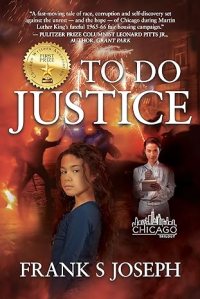
Review: To Do Justice by Frank S. Joseph

Synopsis:

Set during the riots of 1965-66, To Do Justice tells the story of Pinkie, a mixed-race child of Chicago’s meanest streets … and Mollie, a lovelorn (white) reporter in the Chicago bureau of The Associated Press. Together this unlikely pair will track down the white woman who gave Pinkie birth, and score a Pulitzer-worthy scoop in the bargain.

Favorite Lines:

“Now I’m a pretty solid person. Most of the time I’m good at ignoring my impulses. It’s the German blood on Mom’s side maybe.”

“I responded that I’d felt discriminated myself – about my weight, my acne, the fact that I’m a single woman in a man’s world.”

My Opinion:

I received a copy of this book from the author in exchange for my honest opinion.

To Do Justice is book three in Joseph’s The Chicago Trilogy. I have not read the other two in the series yet but it seems like each book can serve as a stand alone. In this book, readers find themselves dropped in the middle of the 1960s Chicago riots and all that comes with them. While there are many characters in this story, the main characters include a biracial girl who is forced to the streets by her foster parents and a white reporter who befriends her and agrees to help solve the mystery of her parentage. This vaguely reminded me of the TV show “I Am the Night” which also takes place in the 1960s and has a reporter helping a girl uncover her heritage. The show is set in Los Angeles and Nevada and is inspired by true events with secrets surrounding the Black Dahlia murder.

This story is for anyone who is interested in reading about the conflicts that arose during the 1960s, especially in Chicago. I felt immersed in the world that Joseph created from the descriptions of the scenes to the dialogue used during the conversations. Joseph does an excellent job at examining questions around gender and identity, racial politics, and the over arching question of what the value of human life is. While the story takes place in the 1960s, a lot of these themes are still prevalent today and Joseph shines a light on them in a creative way.

Summary:

Overall, if you like historical fiction that revolves around racial conflicts that examine race, identity, and politics especially in the setting of the Chicago riots in the 1960s, then this book could be for you. You can find the book trailer here. Happy reading!

Check out To Do Justice here!