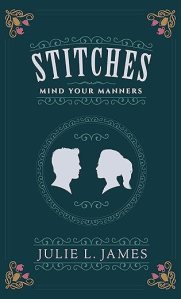
Review: Stitches by Julie L. James

Synopsis:

After an unpleasant experience getting stitches leaves her disenfranchised with doctors, Hero Atticus Taylor decides to be proactive. Capitalizing off of her literary-inspired name, she creates the Hero Atticus Taylor School of Manners for All Doctors, and uses both her prejudice toward doctors and her passion for Emily Post to educate medical students in all forms of etiquette. Her job has been a fulfilling and successful endeavor, until an agitating interaction with a former heart surgeon has Hero’s manner betraying her.

Doctor Lee Taylor is interested in enrolling the surgical students he oversees in Hero’s manners school but he can’t help himself from asking her on a date within minutes of meeting her. He is direct, decisive, and confident. Hero’s refusal and assumption that he is just like every other doctor who belittles her profession, only makes her more interesting to him. Even though he is completely smitten with Hero, Lee cannot see to gracefully reveal his secrets as their courtship continues.

Favorite Lines:

“If you leave this school having learned one thing, let it be this: Manners are the glue of society.”

“Don’t you all think she should have to go out to dinner with me to make up for the ruined sweater, and the permanent scar I’ll have on my stomach until I die?”

“Yes. My doctors permit me to have two cups a day. One with children so that I can scare them half to death, and one with a beautiful face for the evenings.”

My Opinion:

I received a copy of this book from the author in exchange for my honest opinion.

Julie L. James’s Stitches starts with what feels like a rom-com collision in a hospital corridor: Hero Taylor, etiquette coach extraordinaire, is determined to civilize doctors, while superstar surgeon Dr. Lee Taylor strides in convinced he needs no polishing. Their very first run-in—complete with an airborne water bottle—makes it clear the book will balance slapstick energy with a sharp look at professional pride.

Hero’s crusade for better bedside manners grew out of a childhood accident that left her literally stitched together and philosophically convinced that courtesy saves lives. The classes she runs at her “Madhatters School” offer endless comic fodder as she pits teacup drills and mock-patient role-plays against Lee’s arched-eyebrow scepticism. Their back-and-forth lands because both characters mean well; it’s just that one teaches polite small talk and the other performs trauma surgery.

Halfway through, the story pivots: Lee reveals a personal health crisis that suddenly makes Hero’s lessons feel less like window dressing and more like survival gear. The tension between keeping calm for patients and facing your own mortality gives the romance real weight, turning former sparring partners into reluctant confidants.

James keeps the mood light with zippy dialogue and meme-ready banter, yet she layers in enough medical detail and emotional honesty to ground the comedy. Late-night heart-to-hearts, a chaotic children’s tea party, and a surprisingly tender discussion of Greek myths all showcase writing that moves smoothly from laugh-out-loud to lump-in-throat without whiplash. The result is a love story that respects both the scalpel and the spoon.

Summary:

Overall, Stitches is a breezy weekend binge for readers who like their enemies-to-lovers stories sprinkled with hospital drama and anchored by genuine stakes. Expect quick laughs, a few gut-punch moments, and the feel-good reminder that a little kindness—delivered at exactly the right moment—can be as healing as any procedure. Happy reading!
Check out Stitches here!


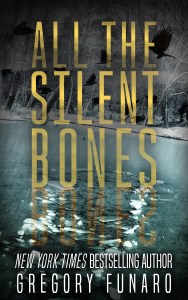
Review: All the Silent Bones by Gregory Funaro

Synopsis:

When they were boys, Ray Dawley, Eddie Sayers, and Matthew Kauffman were the best of friends. Then new kid Bobby “Bones” Bonetti fell through the ice at Blackamore Pond. The other boys saved Bobby from drowning, but something else came out of the water that day, something dangerous that would tear their friendship apart and set one of them on a dark path.

Forty years after the incident on the ice, Ray, a retired college professor, has moved back into his childhood home. Eddie is a retired homicide detective, and Matthew is a successful investment banker. Bobby, who is on disability from his job as a corrections officer at a juvenile detention center, has a secret: the darkness that found him under the ice when he was a kid has made him do terrible things.

Following a reunion at Ray’s house, Matthew is found murdered in his car beside the old pond. The killer includes a chilling message that only the three remaining friends would recognize. Could one of their own be a murderer?

All the Silent Bones, a tense and disturbing thriller told from alternating perspectives of morally complex characters, explores the lasting impact of childhood trauma and its influence on adult relationships.

Favorite Lines:

“You make plans, you prepare for war, you work hard to ensure your kid stays far away from the front lines so that when you see the enemy on the horizon, you’re ready to hit them back with everything you have without collateral damage. But it was also important to make time to play, to get lost in it with abandon—like a child on a snow day. All the worries buried far beneath the pristine white.”

““I always loved you. Even when I didn’t know how.”

My Opinion:

I received a copy of this book from the author in exchange for my honest opinion.

Gregory Funaro’s All the Silent Bones is a chilling, atmospheric thriller that balances psychological horror with literary nuance. Set in Rhode Island and steeped in childhood trauma, abuse, and dissociation, the novel follows Ray Dawley and David Ruggieri as they struggle with the legacies of their pasts and the spectral presence of “Bones”—a dark alter ego that may be more than just a psychological construct.

At its core, All the Silent Bones is a story about memory, trauma, and the brutal ghosts of childhood. The narrative explores the complicated psychological effects of abuse through the lens of dissociative identity disorder, giving shape to an internal world where elves, shadows, and monsters are metaphors for brokenness—and sometimes frighteningly real.

Funaro’s prose is both sharp and lyrical. The characters—particularly Dave/Bones—are unforgettable in their complexity. Bones, the snarling, darkly comedic, and tragically constructed alter ego, becomes the emotional center of the book, embodying both horror and heartbreak. Dr. Natalia Morris, the therapist unraveling Dave’s fractured psyche, serves as a grounded counterbalance to the surreal and disturbing revelations that emerge.

The book isn’t for the faint of heart. It does not flinch from describing graphic abuse, dissociation, and the descent into mental illness, but does so with care, intent, and a deep understanding of its psychological subject matter. There’s a sense of dread throughout that builds slowly and lands with real emotional weight. The themes are heavy, but handled with deftness and honesty.

Funaro’s ability to blend horror and heartbreak is what elevates this book. While the elves and alternate personalities add a supernatural edge, the real terror comes from the raw portrayal of pain, abandonment, and the desperate need to be loved.

Summary:

Overall, a dark and devastating psychological thriller, Gregory Funaro’s All the Silent Bones is a brutal but beautifully told story about the lingering damage of childhood abuse and the fragile hope of healing. It’s an unflinching exploration of trauma and identity, laced with eerie symbolism and grounded by authentic human emotion. Highly recommended for fans of psychological horror, literary thrillers, and trauma-informed storytelling. Happy reading!

Check out All the Silent Bones here!


Review: With Time to Kill by Frank Ferrari

Synopsis:

Everyone deserves a second chance, but how far would you go for one?

In the gritty streets of Edinburgh, Garry Plumb is about to find out. Living life on the periphery, never fitting in and always on his own, Garry’s world opens up when he meets Billy, the peculiar bus driver who has been watching him. Billy knows exactly how it feels to be ignored and his influence on Garry is immediate.

For the first time, Garry knows what it means to have his very own best friend. But this friendship is unlike any other, as Billy reveals how Garry can fix his entire life by changing his past.

But when the DCI John Waters, a relentless detective hunting a clever serial killer, enters Garry’s life, their friendship is put to the ultimate test.

Garry is willing to do anything for a second chance at life but, after meeting Billy, he has to ask would he kill for it?

This dark and captivating tale of self-discovery, murder and redemption will keep readers on the edge of their seats. With Time to Book One, a perfect blend of Scottish crime and sci-fi thriller, will leave you wanting more.

Favorite Lines:

“Good morning, fabulous Major Investigations Team of this fair city.”

“It was clear to anyone observing Waters and his team that the level of respect he commanded and, in turn, the support he provided was unparalleled.”

“The sky was clear and the air a little muggy, which was great for the flowers. Doing not nearly so well was the salmon pink shirt Billy wore, which threatened to show the world exactly what his nipples looked like as he made his way to the hospital.”

My Opinion:

I received a copy of this book from the author in exchange for my honest opinion.

Frank Ferrari’s With Time to Kill doesn’t so much open as detonate. Within the first few pages we meet Garry Plumb, an Edinburgh every-man whose crippling invisibility at the office hides a far darker secret: he is also “one of the most prolific serial killers no one has ever heard of”. Ferrari drops that bombshell with such off-hand confidence that you know you’re not putting this book down after that.

From there the book splits its focus between Garry’s quietly methodical murders and Detective Chief Inspector John Waters, a rum-voiced Highlander whose Major Investigations Team is scrambling to explain a sudden spike in corpses around the city. Waters’s squad-room banter—equal parts gallows humour and procedural grit—gives the thriller its pulse, and the moment they realise all the victims were “assigned female at birth” the anxiety kicks up a gear. Running parallel is the oily bus-driver Billy Blunt, whose cheerful note slips under Garry’s fingers at lunchtime and drags the story into a gloriously seedy pub called The Northern Lights.

What elevates the novel beyond a straight serial-killer chase is Ferrari’s time-travel conceit. Garry isn’t just killing; he’s pruning history with an organic device he calls a “Carrier,” hopping back to erase abusers and bullies before they ever bloom. The ethical whiplash is terrific fun: one minute you’re rooting for him as avenging angel, the next you’re recoiling as the body-count rises. Ferrari keeps that moral compass spinning but never lets the sci-fi mechanics bog the narrative; the rules are clear enough to follow yet just sketchy enough to stay unnerving.

Stylistically, the prose lands somewhere between Tartan Noir and Blake Crouch’s twisty thrillers. Ferrari writes working-class Edinburgh with an affectionate sneer—sticky pub carpets, passive-aggressive rain, and HR managers you’d cheerfully shove off North Bridge. The pacing sprints, brakes, then careens again, and while a couple of subplot threads feel set up for book two, the central cat-and-mouse delivers the promised gut-punch. A special shout-out to Waters, whose Occam’s-razor lecture is the most charming digression on medieval philosophy I’ve read in a police procedural

Summary:

Overall, With Time to Kill is a gleefully dark mash-up of police procedural, serial-killer horror, and high-concept time travel. If you like your thrillers smart, Scottish, and just a little bit unhinged, clear an evening—you’ll race through this and immediately want the sequel. Happy reading!

Check out With Time to Kill here!


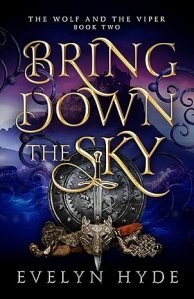
Review: Bring Down the Sky by Evelyn Hyde

Synopsis:

What do you do when your only safe haven is overrun by monsters?

With Silverwood under attack, Spymaster Vendrick Caecillion’s instinct is to plan. It’s to counterattack from the shadows. It’s to never expose your underbelly and never reveal your hard-kept secrets.

But to save his sister from the ruthless Unseen, he’ll have to break all of his old rules.

Swordswoman Frelia Valerius’ instinct is to fight. To charge forward and, yes, risk her life in others’ defense, if that’s what it takes to win. It’s to never surrender and never yield.

But how can she move forward when the dead keep trying to claw her back?

The Unseen will stop at nothing to claim all nine of the sacred Bloodrunes, and no one is safe from their hateful plans—not even the dead. To save Vendrick’s little sister, Frelia’s hometown, their students, and themselves, Frelia will have to face the past she hasn’t yet buried, and Vendrick will need to silence his doubts for good.

For if they can’t, world-ending monsters will only be the beginning.

Favorite Lines:

“What glitters like gold but hangs heavy as a stone?”

“What is done may only be answered for, and what is made can only be destroyed.”

“You, love, kept cracking my masks. And I had far fewer of them, as a student, so you were the first person in a very long time to just see… me.”

“…and he had no words for how much I’d bring down the sky for you echoed in his ears.”

My Opinion:

I received a copy of this book from the author in exchange for my honest opinion.

In Bring Down the Sky, Evelyn Hyde unleashes an epic continuation of her The Wolf and The Viper saga—a sprawling fantasy infused with wit, grit, and emotional intelligence. With rich worldbuilding, sharp character interplay, and moments of sheer cosmic awe, this book is a standout in the indie fantasy space and a testament to Hyde’s maturing narrative voice.

The story continues the journey of Frelia and Vendrick, two figures caught in the storm of rebellion, arcane secrets, and the shadowy threat of the Unseen. Hyde wastes no time plunging readers into complex interpersonal dynamics and existential peril. The pace is brisk but never rushed, balancing large-scale conflict with intensely personal moments of doubt, love, rage, and loyalty.

One of Hyde’s greatest strengths is dialogue. It crackles with sarcasm, warmth, and tension—sometimes all at once. Characters feel lived-in, full of contradictions and tenderness beneath their armor. Deadcut, in particular, brings levity and depth, while Vendrick’s arc explores trauma and self-worth with nuance rarely seen in the genre.

The magic system—based on Bloodrunes, darkbeasts, and spellbooks—is creative and well-integrated, never overwhelming the story’s emotional core. And while the action is cinematic (especially a pulse-pounding rooftop showdown with a monstrous Lord Huginn), it’s the quiet moments—of betrayal, bonding, and hard-won trust—that linger.

Hyde also lets the book play with genre conventions. Political intrigue, magical academia, gothic horror, and found family tropes blend into something wholly her own. Fans of Tamsyn Muir or Leigh Bardugo will find plenty to love, but Hyde’s voice is refreshingly unique.

This is a fantasy with heart. A story where emotional honesty matters as much as magical might. And if the last few chapters are any indication, the saga still has plenty of teeth—and secrets—left to bare.

Summary:

Bring Down the Sky is a fierce, funny, and often deeply moving fantasy that pushes its characters—and readers—to grapple with identity, loyalty, and legacy in a world on the edge of unraveling. If you’re searching for a richly layered, character-driven epic that still knows how to have fun (and make you feel things), Evelyn Hyde’s latest installment should be at the top of your list. Happy reading!

Check out Bring Down the Sky here!


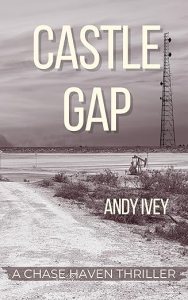
Review: Castle Gap by Andy Ivey

Synopsis:

Castle Gap: A Chase Haven Thriller
In Horsehead Crossing, Texas, Chase Haven was finally feeling at home—until his girlfriend, Tacy Vernon, vanished under a wide, uncaring sky. She dared to defy the town’s bombastic mayor and scheming city manager, exposing a legacy of corruption that’s bled the land dry for generations. Now, Chase leads a desperate fight for her truth in a place that reeks of diesel, decay, and buried secrets.
A sabotaged radio tower crackles with static, whispering tales of betrayal. A body rots in a sewer pump station, too far gone to identify. Every dusty road Chase treads leads him deeper into a web of greed, where desperate men will stop at nothing to protect their power. Fists crack, shots ring out, and the air hums with unspoken lies. In a town hellbent on silence, Chase will risk everything to uncover what happened to Tacy.
Forged by Andy Ivey, a fifth-generation Texan and former KCLW 900 AM host, Castle Gap draws from the wild lore of rural Texas airwaves he knows by heart. This fast-paced rural thriller, perfect for fans of C.J. Box, is a tale of a man who is dragged beyond his moral lines in a land that keeps score.

Favorite Lines:

“You know the people of our town are too stupid to understand the airport!”

“That man is what you call the south end of a northbound horse.”

“Work to live, not live to work.”

My Opinion:

I received a copy of this book from the author in exchange for my honest opinion.

In Castle Gap, Andy Ivey crafts a compelling narrative set in the fictional West Texas town of Horsehead Crossing. The story follows Chase Haven, a newcomer who becomes entangled in local politics when he refuses to co-sign a questionable loan. This decision sets off a chain of events involving his girlfriend, Tacy Vernon, an economic development officer who is abruptly fired after challenging the town’s power structures. As Chase and Tacy delve deeper, they uncover corruption tied to a proposed airport expansion and the influential Baxter Whitey. The novel explores themes of civic responsibility, moral courage, and the complexities of small-town dynamics.

What makes Castle Gap so gripping is how deftly Andy Ivey blends humor, political intrigue, and emotional nuance into a story that feels both contemporary and timeless. The small-town backdrop is rich in personality and dysfunction, giving the novel the feel of a modern-day western wrapped in a government procedural. Ivey’s writing captures the unspoken rules and alliances of rural communities, where everyone knows everyone—and pretends not to.

Chase is a likable anchor for the story: quiet, decent, and skeptical of authority. But it’s Tacy who steals the spotlight. Her transformation from small-town bureaucrat to outspoken advocate is both believable and empowering. I appreciated how Ivey gives her space to be frustrated and afraid while still showing up to fight. Her radio interview scene was one of the most satisfying, especially when she refuses to back down from naming names.

The novel also smartly avoids falling into cliché. The villains aren’t cartoonishly evil—they’re polished, polite, and embedded in the system, which makes them far more dangerous. Ivey doesn’t write in absolutes. Instead, he lets the characters wrestle with difficult choices and ethical gray areas. The conflict over the airport loan, while local, mirrors broader issues of power, transparency, and how public resources get manipulated for private gain.

If you’re someone who loves character-driven political drama with a Texas twang and a slow burn of tension, Castle Gap will absolutely deliver. It’s equal parts cozy and confrontational, with sharp dialogue and an ending that satisfies without tying things too neatly. I’m hoping this isn’t the last we see of Chase Haven—because Horsehead Crossing feels like it still has secrets to give.

Summary:

Overall, Castle Gap is a thought-provoking and engaging novel that delves into the challenges of standing up against entrenched systems. Andy Ivey delivers a narrative that is both entertaining and reflective, making it a worthwhile read for those interested in stories about moral courage and community dynamics. Happy reading!

Check out Castle Gap here!


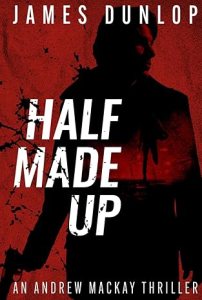
Review: Half Made Up by James Dunlop

Synopsis:

How far would you go for a friend? Andrew MacKay, the sort of man who’s more likely to bet his last penny on a losing horse than lift a finger for anything resembling responsibility, is about to find out. An incurable gambler, chain-smoker, and binge drinker, Andy’s only real talent lies in outliving his own poor choices. But when his mate is shot dead and robbed of a classified secret, Andy finds himself bound to retrieve it, purely out of loyalty and an alarming lack of common sense.

Andy learns the stolen secret is a new nerve agent deadly enough to make any terrorist giddy with joy. Wanting nothing more than to ignore the whole thing, he finds himself drawn into a web of corporate espionage, government corruption, and terrorists with excellent taste in chemical warfare. He’ll have to rely on his wits to stay one step ahead of MI-5, who want him behind bars, if he hopes to recover the secret, and stop the zealots from killing thousands.

Time is running out. Andy’s got only one chance to make things right. Can he do it?

Favorite Lines:

“You’ve certainly put your Bowflex to good use.”

“…efficiency is a highly-developed form of laziness.”

“But I want to die doing something like this, something I hate. That way I won’t have to finish it.”

My Opinion:

I received a copy of this book from the author in exchange for my honest opinion.

James Dunlop’s Half Made Up is a razor-sharp, whip-smart thriller that blends satire, spycraft, and introspective noir into one hell of a ride. The story follows Andy MacKay, a disgraced ex-military man turned reluctant operative, who careens through a vividly sketched London filled with rogue agents, cryptic clues, slippery allies, and more than a few fists to the face.

MacKay is the ideal narrator for this noir-meets-modern-espionage tale—cynical, self-deprecating, and barely held together by caffeine, whisky, and muscle memory. Dunlop’s voice is rich with wit and wry observation, and his protagonist’s internal monologue walks the line between hilarity and heartbreak with real finesse.

At its core, Half Made Up is about blurred lines—between truth and fiction, law and disorder, loyalty and survival. What begins as a rogue inquiry into a murder snowballs into a much deeper conspiracy involving nerve agents, shady intelligence units, extremist networks, and betrayals that cut to the bone. Yet amid the action and political maneuvering, there’s a striking emotional undercurrent, particularly in MacKay’s fractured relationships—with women, with his past, and with his own moral compass.

The writing is punchy and cinematic, with pacing that rarely relents. From pub ambushes and tube-station chases to backroom beatings and breathless getaways, every chapter ends with a hook sharp enough to pull you through the next. But Dunlop never skimps on texture—his similes are deliciously absurd, and his asides are often more telling than the action.

Summary:

Half Made Up is a blistering, witty, and emotionally resonant debut that proves James Dunlop has the chops to stand alongside authors like Mick Herron and Ian Fleming. If you like your thrillers with more punchlines than platitudes—and aren’t averse to your heroes being half-unhinged—this book deserves a place on your shelf. Beneath the biting humor and barroom brawls is a novel that asks serious questions about morality, manipulation, and memory in a world where everything might be… well, half made up. Happy reading!

Check out Half Made Up here!


Review: No Stars: Victor Wolff Book 1 by Henri Leag

Synopsis:

Victor buried his conscience long ago—six feet deep beneath a smile he perfected under the training of Adolf Wren, the merciless head of a corporate empire that spans the galaxy. He was trained to be heartless. Ruthless behind a polished mask.
But redemption has a way of clawing its way back to the surface. When Victor is hired to rescue Marilyn Finch, the daughter of Wren’s bitter rival Norton Crow.
In this gripping interstellar thriller, Victor must confront the enemies closing in on every side, and bring Wren’s empire crumbling down on the secrets that make up its foundation. But how can he do that without giving in to the very monster he’s trying to escape?

Favorite Lines:

“Power, the most valuable resource in the universe.”

” The phrase ‘ignorance is bliss’ comes to mind. He wishes for ignorance now. But knowing. Knowing is a curse. Knowing has him in a terrible grip, and it won’t let him go until he does something about it. He knows he can’t go back. No matter what he tells himself, he can’t go back.”

“The contrast between the two rooms is like the contrast between light and shadow. There’s no dancing in the sitting room. No real smiles here. It’s all fake happy.”

My Opinion:

I received a copy of this book from the author in exchange for my honest opinion.

Henri Leag’s No Stars is a sleek, gripping noir thriller that pulls readers into a world where power is currency, trust is a weakness, and survival depends on making the right move before it’s too late. Set in the towering metropolis of Urbis—a city of wealth, corruption, and hidden dangers—the novel follows Victor Wolff, a man who knows how to play the game. As a high-level consultant, his job is to navigate the shadowy corridors of influence, ensuring those in power stay there. But when a new job forces him to choose between ambition and survival, Victor quickly realizes he’s in deeper than ever before.

Victor Wolff is the perfect noir anti-hero—calculating, composed, and always three steps ahead. He’s a man who understands that words can be sharper than knives, and in Urbis, that’s how you stay alive. But while he thrives in the game of deception, No Stars doesn’t just present him as an untouchable figure—it peels back the layers of his confidence, revealing cracks in his armor. His biggest strength isn’t his power; it’s his ability to read a room, manipulate a conversation, and know when to walk away.

Urbis itself is a character in the novel, dripping with wealth and excess at the top while the lower levels are filled with people trying to climb their way up. Leag paints a cinematic world of gold-trimmed tuxedos, penthouse meetings, and whispered threats over expensive whiskey. The novel’s setting is sleek, stylish, and brimming with an undercurrent of danger—like Blade Runner meets John Wick, where every handshake hides a dagger and every ally could be the next enemy.

The novel’s pacing is razor-sharp, each chapter tightening the noose as Victor realizes that the game he’s playing might not have a way out. There’s always another layer to the deception, another move on the board, and just when he thinks he has control, the rules change. The tension never lets up, keeping readers locked in as Victor fights to stay ahead of the storm. At its core, No Stars is about power—who has it, who wants it, and what it takes to hold onto it.

Summary:

Overall, for fans of noir thrillers, political intrigue, and high-stakes deception, No Stars delivers in every way. Henri Leag has crafted a fast-paced, intelligent thriller that is as stylish as it is intense. With a protagonist you can’t look away from and a world where every choice has consequences, this is a novel that lingers long after the final page. Happy reading!

Check out No Stars here!


Review: The Cobbler’s Crusaders by Rick Steigelman

Synopsis:

Jacquelyn Pajot is a nine-year-old American girl whose excitement over a solo visit to her grandmother in Paris is soon diminished by the discovery that the grandmother is far more devoted to dragging her to church every day than she is in showing her the much-anticipated sights of the city. Jacquelyn’s despair is remedied when she meets a pair of local girls, Nicolette and Genevieve, who are only too happy to lead the American astray. Jacquelyn, to her giddy astonishment, finds herself cajoled into joining her young companions in singing for money on the streets of Montmartre and leg kicking for laughs before the doors of the Moulin Rouge.

Jacquelyn’s joy over this ‘new’ life is tempered when she learns the circumstances of Genevieve’s father, a charming but financially struggling cobbler. Employing her own creative skills to produce a flier, Jacquelyn devises an advertising campaign that quickly spirals out of her control and into the hands of her more mischievous friends. By means both legal and not, the two French girls set a dubious course that has Jacquelyn flirting with the prospect of prison, purgatory and, most perilously, her grandmother’s righteous indignation.

Favorite Lines:

“Who needs the Eiffel Tower when you have Madame Le Preuvier’s goldfish tank? And I’ll bet the line to visit is a lot shorter.”

“Maybe it would be better if you went back to saying this stuff in French, so I wouldn’t have to listen to it anymore.”

“If you take me to the Eiffel Tower today instead of to church, I promise that I’ll move to Paris and push you around in a wheelchair when you get old!”

My Opinion:

A charmingly whimsical, whip-smart slice of Parisian life wrapped in equal parts heart and humor, The Cobbler’s Crusaders is one of those rare books that manages to feel old-fashioned and refreshingly modern at the same time. Rick Steigelman’s prose is wry, warm, and beautifully descriptive, capturing the magic of Montmartre through the curious, wide eyes of young Jacquelyn Pajot.

The story centers around nine-year-old Jacquelyn, freshly arrived from America to spend a week with her formidable and sharply opinionated French grandmother, Catherine Pajot. As the two navigate family tensions, cultural misunderstandings, and the quirky routines of Parisian life—daily Mass, neighborhood gossip, artistic ambitions, and foie gras mishaps—their relationship becomes a quietly moving study in generational contrast and reluctant connection.

One of the joys of this novel is its immersive world-building—not of a fantasy realm, but of a deeply real, vibrantly lived-in Paris. From the chaotic beauty of the Place du Tertre to the dizzying climb to Sacré-Cœur, every setting is lovingly rendered. But it’s the people who make the place come alive: the kindly Berniers, the sad and spirited Madame Le Preuvier and her aquarium of “dead husband” fish, and of course, Minuit the judgmental black cat.

Jacquelyn herself is a standout protagonist—funny, clever, and never afraid to speak her mind, whether she’s musing on duck liver or grappling with the unspoken expectations of grown-ups. Her comic timing and sense of wonder are delightful, and her interactions with Catherine—often barbed but never cruel—offer a touching portrait of a grandmother and granddaughter gradually learning how to meet each other halfway.

What really sets this book apart is Steigelman’s narrative voice: part Wes Anderson whimsy, part Parisian satire, and all heart. The fourth wall breaks, the sly jabs at cultural stereotypes, and the surprising emotional depth lurking beneath the humor all contribute to a story that’s as layered as a perfectly baked croissant.

Summary:

Overall, if you’re in the mood for something offbeat but grounded, funny yet poignant, and filled with the kind of observational detail that makes even the smallest moment sing, The Cobbler’s Crusaders is a journey worth taking. It’s not just a week in Paris—it’s a week in the emotional lives of people who are messy, loving, ridiculous, and completely real. Happy reading!

Check out The Cobber’s Crusaders here!


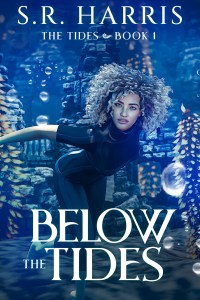
Review: Below the Tides by S.R. Harris

Synopsis:

Growing up in the inner-city ghetto of South Philly, eighteen-year-old River Matthews always felt different. It’s not just her biracial heritage that makes her stand out. In a neighborhood where most of the girls are too concerned with getting their hair wet, River’s love of the ocean makes her an enigma.

On a rainy night where she is saved by a handsome, albeit strange stranger, River finally learns the truth of her missing heritage.

Whisked away to the underwater world of Arcaccia, she finds the father she always wondered about, a brother she didn’t know existed, a love she wasn’t looking for, and a world she would do anything to save

Join this inner-city girl as she as goes on an adventure of a lifetime and finds love, and the family she didn’t know she was missing.

Favorite Lines:

“He loved the sea more than anything, it’s the reason why I named you River. I wanted you to have a piece of him even if in the end, he took another path.”

“After we saw Black Panther, she used to say maybe he was the king of a secret place like Wakanda, but for white people. “

“I mean, it really is like my life turned into a fucking book and if I am being honest, it’s not quite as fun as I thought it would be.”

My Opinion:

S.R. Harris plunges readers into a richly imagined undersea world with Below the Tides, a young adult fantasy that deftly weaves urban grit with aquatic magic, family legacy, and self-discovery. River, a biracial girl from Philadelphia, always felt drawn to the water. But when she learns her father is the ruler of a hidden underwater kingdom, Arcaccia, her fascination transforms into a destiny that will upend her world—and possibly save it.

River is a strong, layered protagonist: grounded, witty, vulnerable, and brave. Her journey is full of twists—from discovering the truth about her lineage to confronting betrayal and love beneath the waves. The depiction of her tight bond with her best friend Mecca adds warmth and humor, while her evolving romance with Sylas brings moments of intensity and tenderness.

What makes Below the Tides stand out is its blend of voice and world-building. Harris gives us everything from tight-knit friendships to political intrigue, from immersive battle scenes to tearful reunions. The tone moves effortlessly between laugh-out-loud funny and soul-piercingly emotional.

The underwater kingdom of Arcaccia feels alive—complete with shimmering domes, magical communication through water, and a rich mythology built on ancestral duty and magic. The themes of identity, chosen family, and empowerment are threaded throughout without feeling forced.

While the novel leans heavily into romance and adventure, it’s the deeply personal stakes—River’s struggle to define herself amidst chaos—that resonate the most.

Summary:

Overall, if you’re looking for a story that’s part Aquaman, part Black Panther, with a dash of The Little Mermaid and a healthy scoop of Philly grit—this is the one. A must-read for fans of fast-paced fantasy with heart. Happy reading!

Check out Below the Tides here!


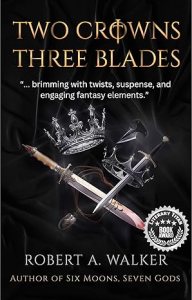
Review: Two Crowns, Three Blades by Robert A. Walker

Synopsis:

“Revenge is a temptress, full of promise, but she rarely satisfies… and almost always exacts payment.“

Still grieving over the loss of his wife and daughter, King Axil of Aranox declares war on The Guild of Takers. The GOT’s High Order responds, strengthening its efforts to kill both of Baelon’s monarchs. Tristan Godfrey seeks his brother’s murderer, and true love is made to wait again as Sibil Dunn embarks on a solitary crusade. Saved from the guillotine, Overseer Reynard Rascall looks to avenge Spiro’s death, while retired Royal Guard, Rolft Aerns, recovers from his wounds and puts away his sword—until, that is, he learns of Sibil’s quest.

And all of Baelon hangs in the balance.

The Legends of Baelon, Book Two

Favorite Lines:

“Some things are worth pursuing even though they don’t exist.”

“Evil knew better. It paid no heed to climate, color, or emotion. It did not restrict itself to the dark recesses of places easy to avoid.”

“Even the victor pays a price.”

My Opinion:

I received a copy of this book from the author in exchange for my honest opinion. 

Two Crowns, Three Blades is book two in The Legends of Baelon series by Walker. It follows Six Moons, Seven Gods which I reviewed last year – you can find the review link here.

Robert A. Walker’s Two Crowns, Three Blades is an immersive fantasy adventure filled with political intrigue, deep-seated betrayals, and the weight of destiny. The novel follows Sibil Dunn, a young woman grappling with loss, visions, and the intricate web of alliances and conflicts surrounding the realm of Aranox. A tale of vengeance, power, and self-discovery, Walker crafts a world teeming with rich mythology, compelling characters, and the tension of a kingdom on the brink of war.

At the heart of the story is Sibil, a heroine burdened by grief and driven by a relentless determination to carve her own fate. Following the tragic murder of her mother and the mounting instability in the kingdom, she seeks a place among warriors, hoping to avenge those she lost. But her journey is far from simple—kings and marshals attempt to control her fate, while shadowy forces conspire against the realm. As she navigates an unforgiving world, her visions of the future become both a gift and a curse, revealing glimpses of a destiny she can’t yet understand.

Walker’s storytelling is layered, combining action with introspective moments that explore duty, identity, and the personal cost of war. The political maneuvering between kingdoms, the enigmatic magic woven through the lore, and the deeply personal stakes make for a thrilling yet emotionally gripping read. From dreamlike prophecies to brutal battle preparations, every moment in Two Crowns, Three Blades feels weighty, building toward an explosive climax.

Summary:

Overall, for fans of high fantasy rich with character-driven drama and well-crafted world-building, Two Crowns, Three Blades is a must-read. With its intricate relationships, moral dilemmas, and unexpected twists, Walker delivers a tale that lingers long after the final page.

Check out Two Crowns, Three Blades here!