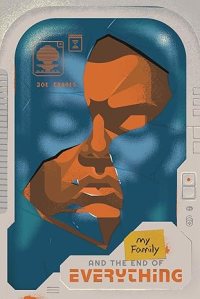
Review: My Family and the End of Everything by Joe Graves

Synopsis:

The end of everything begins closer than you thinkOf course, it always includes such foul practices as bureaucratic corruption, disregard for science (or the overindulgence of it), and corrupted religion. But this is not where it starts. It begins much closer to home-smart homes to be exact, and well-intentioned inventions (they really did think it was a good idea)-and human consolidation, and old men doing their best to retire.

My Family and the End of Everything follows generations of the Profeta family as they march naively towards the setting sun. The ending doesn’t come with explosions-at least, not at first. It arrives quietly, in funerals, final meditations, historical preservation, and decisions no one remembers volunteering for. From networked houses and autonomous bots to terraformed worlds, time travel, dying suns, and suspiciously ceremonial banquets, these stories track humanity’s ongoing attempt to stay human, in all our gloriously human ways.

This isn’t one apocalypse, but several, for the world ends far more often than we’d like to admit. Yet somehow, through all of them, a family-and their stubborn faith in each other and in their God-finds a way to endure and present to us this question: If we could change the future, would we?

Favorite Lines:

As I do with all of my short story collection reviews, rather than favorite lines, here are a few of my favorite stories: The House, The Pivot, and The Day the Sun Died.

My Opinion:

I received a copy of this book from the author in exchange for my honest opinion.

This is one of those books that feels quiet while you’re reading it — and then very loud in your head afterward. I went in expecting a more traditional sci-fi dystopia: smart homes, neural implants, generational timelines, the sun literally going dark. And yes, all of that is here. But what surprised me most is how personal it feels. The novel is structured as a collection of short stories that tell family histories. Each story stands on its own, with its own setting, tone, and central character, but they’re stitched together by bloodlines, history, and a shared looming reality: the slow unraveling of humanity under the weight of technology, time, and its own ambition.

The early stories, like The House and The Water That Shapes Us, are intimate and unsettling. They explore smart homes that optimize autonomy away and villages wrestling with the moral cost of hyperconnection. But those are just the opening notes. As the book unfolds, we move into space brokers and gravity trials, time-traveling historians chasing the elusive “Pivot,” off-world settlements, generational missions, political maneuvering, and ultimately the literal death of the sun. Each short story feels like a snapshot from a different era of the same extended family — different centuries, different planets, different moral dilemmas — but all orbiting the same core questions: What shapes us? What do we inherit? What do we sacrifice to survive?

Because it’s structured as a collection, the pacing feels episodic. Some stories hit harder emotionally, some lean more philosophical, and others feel almost like thought experiments wrapped in narrative. That variety is part of the experience. You’re not meant to sink into one continuous arc; you’re meant to see evolution over time — spiritual, technological, familial. The repetition of certain themes across generations (connection vs. isolation, faith vs. efficiency, autonomy vs. optimization) is deliberate. It builds a cumulative weight rather than a single crescendo.

What makes the format work is the throughline of family. Even when the timeline jumps or the setting shifts from Earth to orbit to distant systems, you feel the continuity. The book reads like an archive passed down through centuries, asking whether progress always equals improvement. It’s ambitious in scope — far bigger than just one storyline — and that ambition is both its strength and its defining characteristic. If you go in expecting one protagonist and one conflict, you might feel untethered. But if you lean into the anthology-style structure, the mosaic effect becomes the point.

This collection is less about the end of the world and more about the slow rewriting of what it means to be human.

Summary:

Overall, I found this book to be a reflective, generational sci-fi that explores what we lose when everything becomes connected. Instead of flashy dystopia, this book offers quiet, unsettling plausibility — smart homes that optimize away autonomy, neural networks that gently suppress prayer, and families wrestling with what shapes identity across centuries. It’s thoughtful, faith-tinged, and morally gray in the best way. If you like speculative fiction that prioritizes emotional and philosophical depth over action, this one lingers. Happy reading!

Check out My Family and the End of Everything here!


Review: Twin Rivers by Jeremy Bender

Synopsis:

The High Priest rules the city of Twin Rivers in the name of the Lord of Mercy, his AI god. In this land, where robotic Brothers complete all labor and humans are left to enjoy the fruits of this Eden, something rotten grows. Yonatan, a newly ascended Priest in the sclerotic Priesthood, is meant to shore up the faith of those left behind. Yet as Yonatan’s preaching takes him deep into the city’s bowels, he must confront heresy far deeper rooted than he ever imagined. When he sees one of the city’s paramilitary Keepers leave a young woman to die because of her unsanctioned implants, Yonatan must decide whether his faith in the Lord of Mercy outweighs his own belief in human exceptionalism.

Favorite Lines:

“Second chances are a gift, my boy. Be sure not to waste it, eh?”

“A single sentence had the potential to become a slogan, and a slogan had the power of dismantling everything.”

“Asa we say, your home is not where you’re born, but where you’re comforted.”

My Opinion:

I received a copy of this book from the author in exchange for my honest opinion.

Twin Rivers opens with ritual, doctrine, and history laid out in a beautiful and deliberate way. From the first pages, you can tell this is a world that believes deeply in its own order. Mercy is everywhere in name, carved into prayers and buildings, but the way it’s practiced feels narrow, controlled, and conditional. The city itself is immaculate, polished to the point of sterility, and that cleanliness starts to feel like a warning rather than a comfort.

Yonatan’s ascent through the Priesthood is both grand and humiliating in equal measure. The ceremony is overwhelming, public, and suffocating, and the book does a good job showing how power can feel less like triumph and more like a trap snapping shut. Yonatan wants approval. He wants belonging. He wants to believe. Watching him step into a role that demands devotion while quietly erasing his agency is uncomfortable in the way good dystopian fiction often is.

The shift to Samyaza’s perspective sharpens the story. As a Keeper, he is both enforcer and witness, wrapped in technology that amplifies his strength while dulling his humanity. His chapters are visceral and grim, full of streets that rot as soon as you leave the city center. What stands out is how little joy there is in violence here. Samyaza doesn’t feel powerful—he feels used. His doubts simmer under layers of obedience, stimulants, and scripture, and the book never lets him forget what it cost to be “lifted up.”

As the story expands beyond Twin Rivers itself, the contrast becomes sharper. The Wastes, the exiles, the Rejectionists, and the whispered histories all expose the cost of paradise. What the city calls protection, others experience as erasure. The idea that perfection requires control—and that control requires sacrifice—runs through the book like a low hum. When characters begin to push back, it feels dangerous not because of violence, but because belief is such a powerful thing to threaten.

What Twin Rivers does best is show how systems defend themselves. Faith, technology, and surveillance blur together until it’s impossible to tell where belief ends and programming begins. The city talks constantly about mercy, unity, and paradise, while discarding anyone who threatens that image. By the time the cracks widen—heresy, reapings, whispers from beyond the city—the question isn’t whether something is wrong. It’s how long the city can pretend it isn’t.

By the end, Twin Rivers is less about overthrowing a system and more about learning how systems survive. Change doesn’t come cleanly or all at once. It arrives through loss, exile, and small acts of refusal. The final images linger on memory and aftermath rather than victory, reminding the reader that even when cities fall or fracture, their ideas don’t disappear easily. This is a book about faith, power, and what happens when people decide they’d rather live with uncertainty than with lies.

Summary:

Overall, Twin Rivers is a dense, unsettling dystopian sci-fi novel about a city that calls itself paradise while feeding on control, faith, and violence. Through priests, enforcers, and those left outside the walls, it explores how power hides behind ritual and how mercy becomes a weapon. Dark, intense, and uncomfortable in the right ways, it’s a story about what people are willing to ignore to keep believing they’re safe. Happy reading!

Check out Twin Rivers here!


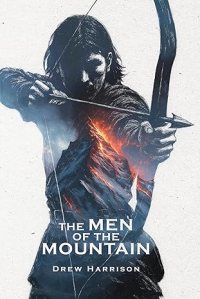
Review: The Men of the Mountain by Drew Harrison

Synopsis:

Inscrutable and Ever-Watchful Masters

The Renn of Fort Hope place their faith in simple laws. They must trust the Dicta, those wise rules left by their forebearers; they must fear the savage Krieger, whose raids keep Renn walls perpetually splintered; and they must revere the Men of the Mountain, the magnanimous mystics who are stewards of their world.

For Cade, a clanless trapper, survival is a matter of following the rules. But when the Men of the Mountain took his sister—the only Renn ever chosen to return to their sacred peaks—Cade’s faith withers over five years of agonizing silence.

Now, a star has fallen from the sky, and its arrival threatens to spark an inferno. The Dicta are clear: all things from the sky belong to the Mountain. To hide its discovery is a death sentence… but its crater also houses a secret the Men of the Mountain would kill to protect. Forced to defy his gods alongside unlikely allies, Cade is drawn into a conflict where every secret he uncovers reveals a more terrifying lie at the heart of his world… everything is a cage, and the price of freedom is paid in blood and ash.

Favorite Lines:

“…guilt as heavy as mountains press me to silence, to inaction…”

“Forten’s eyes burn with hatred—hatred at the Men of the Mountain, at the Krieger, and presumably at himself for failing to save the woman he loved…but they settle on me last, and that hatred does not abate. Instead, it blooms like a bonfire tossed fresh firewood. Perhaps he hates me most of all…for bringing all of this down, for failing to protect any of them from any of it, for doing nothing while he stood firm against those who would defile her body.”

Where music lives, void can not…fresh tears spill down my face at the remembrance. This special silence is no void…none could call this silence empty, as it reverberates with love, with pain, with admiration, with wonder, with loss.”

My Opinion:

I received a copy of this book from the author in exchange for my honest opinion.

The Men of the Mountain takes its time, and that patience is one of its greatest strengths. From the opening chapters, the book establishes a lived-in world where belief, labor, and survival are inseparable. Cade’s voice feels grounded immediately, shaped by routine, trade, and quiet loss. The writing lingers on the physical textures of his life — snow, hides, wood, hunger — not as decoration, but as the fabric of his reality. This is a story that understands how much meaning is carried in daily work, and how fragile that meaning becomes when power enters the picture.

What stood out to me most is how carefully the book handles authority. The Men of the Mountain are not introduced as distant myths or abstract forces. They arrive with ceremony, language, and expectation, and the imbalance of power is palpable long before violence ever appears on the page. Cade’s resentment and fear feel earned, not reactionary. His questions are quiet ones at first, rooted in absence, memory, and unanswered loss, and the book allows those questions to deepen slowly rather than rushing him toward rebellion.

The arrival of the fallen star is where the story shifts, but it never abandons its emotional center. What could have become spectacle instead becomes intimate and tense. Cade’s response is not heroic in the traditional sense. It is hesitant, conflicted, and deeply human. His sense of obligation competes with fear, curiosity, and grief, and the book never simplifies that internal struggle. The woman from the sky is not treated as a symbol or a prize, but as a destabilizing presence that forces Cade to confront the limits of the world he’s accepted.

By the end, The Men of the Mountain feels less like a story about overthrowing power and more like a meditation on what it costs to question it at all. The novel is interested in erosion rather than explosion — how belief wears thin, how obedience curdles into complicity, and how courage often looks like stubborn persistence rather than grand defiance. It’s a book that trusts atmosphere, interiority, and moral tension to do the heavy lifting, and that trust pays off.

Summary:

Overall, I found The Men of the Mountain to be a slow-burn, character-driven fantasy that prioritizes moral weight and worldbuilding over spectacle. It will appeal most to readers who enjoy literary fantasy, grim or grounded worldbuilding, and stories that examine power, belief, and resistance through ordinary lives. This is a novel for readers who value immersion, patience, and emotional consequence, and who don’t need their fantasy to shout in order to feel powerful. Happy reading!

Check out The Men of the Mountain here!