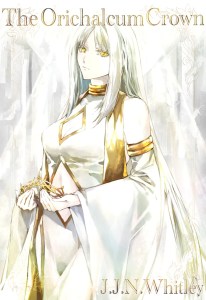
Review: The Orichalcum Crown by J.J.N. Whitley

Synopsis:

Makoto lost her mother to a battle she can’t remember before being adopted into the Kauneus Empire’s royal family. Upon her eighteenth birthday, she receives her mother’s necklace from the emperor. Makoto’s memories slowly return, haunting her with visions of her lost sister and her mother’s murder.

She is torn between the family and answers awaiting her across the sea and the relationships with her family, best friend, and his handsome brother. Makoto fears returning home will cast doubt upon her loyalty to the emperor and sever her from the family. After all, Kauneus has no need for a disloyal princess.

Makoto’s eldest adoptive sister, Athena, remains banished from Zenith Palace for uncovering the emperor’s secret bastard. She is visited by her former dragon uncle, who shares a rumor that the emperor will be assassinated during the annual ball. Athena has no choice but to break her exile to save her father. Returning home risks death, but she’ll pay any price for her family’s safety.

As night falls upon the ball, lurking shadows and hidden agendas threaten the empire’s fragile peace. Makoto and Athena must navigate the delicate lines between loyalty and betrayal and learn what they are willing to sacrifice for freedom, truth, and family.

Favorite Lines:

“Even a good dog could still bite.”

“Of all the things she wanted to remember, now she had something she wished to forget.”

“She burned brightly for those she loved but scorched her enemies.”

My Opinion:

I received a copy of this book from the author in exchange for my honest opinion.

From the very first pages, The Orichalcum Crown feels weighted with memory loss, grief, and inherited responsibility, but it never leans too heavily into melodrama. Instead, it allows those emotions to surface naturally through Makoto’s perspective. What struck me most early on was how tender the writing is even when it’s describing frightening or brutal moments. Pain and wonder exist side by side, which gives the story a softness that makes its harsher scenes more impactful.

Makoto is a compelling protagonist because she isn’t framed as heroic in the traditional sense. She is frightened, uncertain, and often confused, but never passive. The tension between who she is expected to become and who she actually is drives much of the emotional arc. The idea of “beauty in strength” repeats throughout the novel in ways that feel earned rather than symbolic. Strength here is not dominance or fearlessness, but endurance, restraint, and the ability to care when it would be easier to close oneself off.

The political dynamics and family structures add depth without overwhelming the personal story. Emperor Rudolph is especially well written; his affection, cruelty, fear, and pride all coexist in a way that makes him unsettling yet believable. Relationships feel earned, particularly the bond between Makoto and Ephraim, which provides warmth and safety in a story that often feels cold and precarious. These quieter connections ground the larger fantasy elements and make the stakes feel intimate rather than abstract.

What ultimately makes The Orichalcum Crown linger is its refusal to simplify morality. No one emerges unmarked by violence, grief, or compromise. Even moments of love are threaded with loss. The novel trusts the reader to sit with discomfort, to hold conflicting truths at the same time, and to recognize that survival often reshapes people in ways they did not choose. It feels like the beginning of a larger saga, but it stands confidently on its own as a story about identity, power, and the cost of protection.

Summary:

Overall, The Orichalcum Crown may be best suited for readers who enjoy character-driven fantasy, political intrigue, and emotionally grounded coming-of-age stories. Fans of epic fantasy who value internal conflict over constant action will appreciate its pacing and tone. It also works well for readers drawn to themes of grief, found family, and morally complex authority figures, making it a strong choice for those who enjoy thoughtful, atmospheric fantasy with emotional weight. Happy reading!

Check out The Orichalcum Crown here!


Monthly Features – September 2025

The Boy with the Thorn in His Side by L.J. Robson

I received a copy of this book from the author in exchange for my honest opinion.

Synopsis: For most of my life, I felt like something was wrong – like I was living with a shadow I couldn’t see, a weight I couldn’t name. My childhood was marked by fear, confusion, and memories that never quite fit together. I knew there were pieces missing, but I never expected the truth to be more terrifying than my worst nightmares.

This is my story. A journey through trauma, survival, and the battle to reclaim my own mind. It’s about the ghosts of the past that never stopped whispering, the questions no one wanted to answer, and the slow unravelling of a reality I had been forced to forget.

Told with raw honesty, The Boy with the Thorn in His Side is not just an account of what happened to me – it’s a testament to resilience, a fight for acceptance, and a message to anyone who has ever felt trapped by their own past.

Sometimes, the truth is the hardest thing to face. But in facing it, we find the strength to break free.

Summary: Overall, The Boy with the Thorn in His Side is a raw, unfiltered memoir of trauma, resilience, and healing. L. J. Robson takes you into the shadows of his childhood home, unafraid to expose the scars of abuse and the chaos of survival. It’s heavy, often heartbreaking, but threaded with moments of hope and honesty. A difficult yet rewarding read.

See the full review here: The Boy with the Thorn in His Side
Purchase here


The Hidden Life by Robert Castle

I received a copy of this book from the author in exchange for my honest opinion.

Synopsis: The police have just surrounded the hereditary mansion of Gladwynne Biddleton. He has just shot and wounded his security chief, Dominic Kittredge, and killed Dominic’s wife, Theresa. As he watches the siege unfold on TV, historical visions besiege Gladwynne’s mind. By turns he is a B-17 bombardier; an SS officer tasked with burning the bodies of Adolf Hitler and Eva Braun; a fugitive pursued by the celebrated Nazi hunter, Simon Wiesenthal; and a co-conspirator in the assassination of Austrian Archduke Franz Ferdinand and his wife, Sophie, Duchess of Hohenberg.

Between the television coverage and the pageant in his head, Gladwynne becomes dissociated from what has just actually happened. Fixation on his immediate physical needs and with life in the mansion tend to conceal the enormity of his crime from him. He descends into a narrowing and harrowing spiral of isolation.

Why did he shoot his closest confidant, Dominic? We don’t quite know. But in Dominic’s thirty year diary of serving Gladwynne we begin to find clues. In this chronicle, Dominic recounts the “golden age” of their association, a time when the two men devised a mock nation with Gladwynne as its center. With Dominic’s encouragement, Gladwynne came gradually to conceive of his own physical person as a sovereign state, competing diplomatically with other world states, persistently resisting their efforts to deprive him of his sovereignty. Between the hostile international powers out to get him and the police now at his door, will Gladwynne’s confusion become total?

Summary: Overall, Robert Castle’s The Hidden Life is a dark, ambitious novel that intertwines wealth, madness, and loyalty into a portrait of a man unraveling. Both unsettling and absorbing, it’s a story that lingers long after the final page, not just for what it says about one family, but for what it suggests about the hidden lives we all construct.

See the full review here: The Hidden Life
Purchase here


Settle Down by Ritt Deitz

I received a copy of this book from the author in exchange for my honest opinion.

Synopsis: A college kid endowed with hypnotic powers keeps telling himself there’s got to be more waiting for him after graduation than family in the neighborhood and an okay catering job. Maybe he just needs to get his story straight.

Kenny McLuher is far from his native Wisconsin, in his last year at the University of Virginia, majoring in history with no idea what he’s going to do with it. At his catering job, Kenny’s old Southern folktales keep putting his co-workers to sleep, and in Kenny’s dreams President Abraham Lincoln sure seems to be trying to tell him something.

Maybe the pieces will come back together after graduation when Kenny returns to Madison, where he can ask the big question: What is home, anyway?

Summary: Overall, Settle Down is a warm, heartfelt coming-of-age tale about finding home in unexpected places. It’s a quietly triumphant debut that will resonate with anyone who’s ever wondered where they truly belong. 

See the full review here: Settle Down
Purchase here


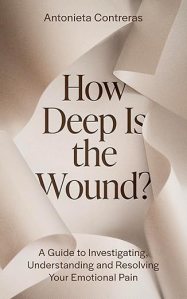
How Deep is the Wound by Antonieta Contreras

I received a copy of this book from the author in exchange for my honest opinion.

Synopsis: Finally, a Clear Path Through the Confusion of Modern Trauma Language

If you’ve ever wondered whether your struggles “count” as trauma, felt overwhelmed by conflicting mental health advice, or questioned why some healing approaches work for others but not for you—this book offers the clarity you’ve been seeking. Today’s mental health conversations have reduced the rich complexity of human suffering into a single box labeled “trauma,” used for both devastating life-altering experiences and everyday disappointments—a confusion that serves no one well. This tendency leaves people either minimizing genuine injuries or pathologizing normal life challenges.

Antonieta Contreras introduces an approach that distinguishes different types of psychological wounds based on their actual depth and impact on your nervous system. Drawing from years of clinical practice, extensive research, and personal recovery, she provides the missing understanding to accurately assess your experiences and match them with effective strategies.

You’ll discover the differences between:

  • Emotional Pain: Hurts that sting but don’t fundamentally alter your system
  • Emotional Wounds: Deeper impacts that linger after the initial hurt
  • Traumatization: The active process of seeking safety
  • Trauma: Deep injuries that rewire how you perceive the world

Learn why using a hammer for surgery or a scalpel for construction both create problems—and how matching your healing approach to your actual wound depth accelerates recovery while preventing unnecessary suffering.

Discover how to honor your pain without being defined by it, moving from identity-based labels toward agency-focused growth that reclaims your power to heal and thrive. This book examines how your unique nervous system responds to overwhelm.

Real-World Applications

  • Assess childhood experiences accurately without minimizing or catastrophizing
  • Recognize trauma bonding and attachment wounds that keep you from living fully
  • Understand why some relationships feel impossible to leave
  • Navigate narcissistic abuse and emotional manipulation
  • Distinguish between healthy processing and rumination that reinforces pain
  • Build genuine resilience based on nervous system regulation

This book is for:

  • Anyone confused about whether their experiences constitute “trauma”
  • People who’ve tried multiple healing approaches without lasting results
  • Individuals stuck in cycles of pain, insecurity, lack of motivation or satisfaction, or relationship difficulties
  • Those seeking to understand childhood experiences and their adult impact
  • Anyone wanting to move beyond victim identity toward empowered recovery
  • Mental health professionals seeking more nuanced assessment tools and practical exercises for their clients

When you understand the actual depth of your wounds, you can choose interventions that match their severity. This prevents both under-treatment that leaves you unresolved and over-treatment that creates unnecessary pathology. You will spend less time on ineffective approaches and focus your energy on strategies that are effective for your specific situation.

This book avoids both toxic positivity and victim mentality, acknowledging real suffering while emphasizing human capacity for growth and adaptation. Learn to work with your nervous system’s intelligence rather than against it. You’ll finish with practical tools for regulation, boundaries, and building the safety your system needs to thrive.

Stop wondering if your pain is “enough” to deserve attention. Learn to honor your experiences and discover what it means to finally feel yourself again. Transform your relationship with your own story and step into the clarity, agency, and hope that effective healing provides.

Summary: Overall, Antonieta Contreras’s How Deep is the Wound?  blends clinical expertise with accessible storytelling to help readers understand the spectrum of emotional pain—ranging from everyday struggles to deep trauma—and argues that distinguishing between them is key to healing. By challenging the overuse of trauma language while offering practical exercises and compassionate guidance, Contreras reframes pain as a sign of our innate adaptability rather than evidence of brokenness, ultimately encouraging readers to approach their wounds with clarity, agency, and hope.

See the full review here: How Deep is the Wound?
Purchase here


Review: Solitude by Sebastian JC

Synopsis:

A young girl lives her day-to-day life in a post-apocalyptic world, confined entirely within the crumbling remains of an old church—the last refuge for a small band of survivors. She is the only child among them, and the wasteland beyond remains a mystery, known only through her daydreams and fleeting glimpses through boarded-up windows and broken towers.
Her story begins with the unexpected death of a fellow survivor—the first loss she has ever known. As grief ripples through the group, their fragile sense of safety begins to fray. Through the girl’s eyes, we see the adults around her struggle to maintain a semblance of normal life and offer her something like a true childhood, even as the dangers of the outside world press ever closer.
Solitude is a novella about found family, survival, and loss, seen through the eyes of a young girl as she tries to understand and come to terms with a world that is ultimately too big, too dangerous, and too indifferent.

Favorite Lines:

“Her world was larger up here; there was more room for possibility and imagination.”

“It was the forever part that was hard to handle. the permanence of it. The idea that someone she had known her whole life, who was always there, was gone. It was hard to think about it. Maybe this is the weight that everyone was feeling all the time. The weight of people being gone, of their lives being different forever.”

“And then she noticed it. Illuminated perfectly in the twilight, the smallest bit of green. A green that she had only seen in books and old pictures.”

My Opinion:

I received a copy of this book from the author in exchange for my honest opinion.

Sebastian JC’s Solitude follows a young girl growing up in the ruins of a church after societal collapse, where a small group of survivors struggles to endure hunger, grief, and the dangers of the outside world. Told through her observant and reflective perspective, the novel highlights the fragile dynamics of a chosen family, the cycles of daily survival, and the weight of loss.

What surprised me most about Solitude is how intimate the story feels despite its post-apocalyptic setting. It would be easy for a novel like this to lean heavily on destruction and despair, but instead, JC builds the world around one young girl’s perspective, grounding the collapse of society in the quiet moments of her everyday life. From her perch in the ruined church steeple to her careful observations of the makeshift family she lives with, the novel is less about explosions and chaos and more about survival through relationships, memory, and the fragile bonds that hold people together.

The writing style is deliberate and unhurried, mirroring the rhythms of camp life. Long passages describe the girl’s walks through ruined hallways, her habit of counting steps, or the way dust filters through stained glass. This might sound slow, but it works; the detail makes you feel like you’re inhabiting her world, and it underscores how, in a life defined by scarcity, attention to small things is survival itself. You begin to see the church and its ruins as she does: not just broken stone and wood, but a place mapped in memory, danger, and imagination.

I also appreciated how the book weaves grief into its structure. The loss of Jav early on is not a plot twist but a weight that echoes through every chapter. Each character absorbs it differently—John through silence and illness, Sandra through relentless caretaking, and the girl through restless wandering and reflection. JC shows how in survival, grief is never private; it seeps into the entire group, shaping decisions, tensions, and fleeting moments of tenderness.

At times, the book risks feeling repetitive—another patrol, another climb, another whispered conversation in the ruins—but I came to see that repetition as intentional. The girl’s world is claustrophobic, defined by cycles of watchfulness and waiting. That narrow focus made the rare bursts of danger or connection stand out all the more. By the end, what lingered with me wasn’t the bleakness of the world outside but the fragile hope inside: the idea that even in ruin, meaning is built in relationships, in ritual, and in holding onto stories of who we are.

Summary:

Overall, Solitude blends post-apocalyptic tension with quiet, detailed storytelling. It becomes less about destruction and more about memory, resilience, and the search for belonging in a fractured world. If you like post-apocalyptical sci-fi and coming-of age stories, then this book could be for you. Happy reading!

Check out Solitude here!


Review: Settle Down by Ritt Deitz

Synopsis:

A college kid endowed with hypnotic powers keeps telling himself there’s got to be more waiting for him after graduation than family in the neighborhood and an okay catering job. Maybe he just needs to get his story straight.

Kenny McLuher is far from his native Wisconsin, in his last year at the University of Virginia, majoring in history with no idea what he’s going to do with it. At his catering job, Kenny’s old Southern folktales keep putting his co-workers to sleep, and in Kenny’s dreams President Abraham Lincoln sure seems to be trying to tell him something.

Maybe the pieces will come back together after graduation when Kenny returns to Madison, where he can ask the big question: What is home, anyway?

Favorite Lines:

“Kenny looked out over the pool, unsure what he had expected from this little pilgrimage. His parents had come here once in college, and it had seemed important to them. Kenny had wanted it to mean something to him, too. Sure, the homeless guy would be memorable, and the Orion thing was weirdly coincidental. And there sat Lincoln, belonging to the ages. But when he imagined the president asking him What are you doing here?, Kenny couldn’t think of any answer at all.”

“We so badly want to stay, don’t we? We belong, we stay, we know. And yet things happen, and some of us leave. We just have to go.”

“It looked like a labor of love. Or boredom.”

My Opinion:

I received a copy of this book from the author in exchange for my honest opinion.

Ritt Deitz’s Settle Down  follows Kenny McLuher, a Wisconsin native in his final year at the University of Virginia, as he grapples with the age‑old question: What is home, anyway? Majoring in history with no clear path beyond graduation, Kenny drifts between lecture halls, late‑night catering shifts, and echoes of Southern folktales he shares—sometimes to the bemusement of his co‑workers. Through Kenny’s gentle humor and restless curiosity, Deitz captures that universal limbo of young adulthood, when every choice feels both urgent and uncertain.

The novel’s heart lies in Kenny’s evolving friendships—especially with Laurent, after a chance encounter by the Yahara River. Laurent’s quick wit and unexpected references to Civil War lore are Kenny’s first introduction to him but certainly not the last. Later in the story, Kenny ends up getting a job at Laurent’s small catering company, which plays a rather large part in Kenny’s life (at least the parts we see in this story). Kenny’s chance encounter with a cryptic stranger, hinting at Orion and otherworldly connections, infuses the story with a subtle magic that mirrors the way history itself can feel uncanny and alive.

Deitz’s writing style is unpretentious and warm, guiding us effortlessly between Kenny’s internal monologue and the vivid campus landscape. The University of Virginia emerges as more than a backdrop—it’s a place steeped in myth and memory, where colonial architecture meets the hum of modern student life. Deitz peppers the narrative with historical allusions—Abraham Lincoln’s unfinished stories, John Wilkes Booth’s shadow—and by doing so, reminds us that every brick and bust on Grounds carries a tale waiting to be rediscovered.

At its core, Settle Down  is a meditation on belonging. Kenny’s Wisconsin roots tug at him even as he finds unexpected comfort in Charlottesville. In Deitz’s hands, the search for “home” becomes both a physical journey—back and forth between Madison and UVA—and an emotional one, as Kenny learns that sometimes the place you’re meant to “settle down” in is less about geography and more about the people who listen when you tell them a story. 

Summary:

Overall, Settle Down is a warm, heartfelt coming-of-age tale about finding home in unexpected places. It’s a quietly triumphant debut that will resonate with anyone who’s ever wondered where they truly belong. Happy reading!

Check out Settle Down here!


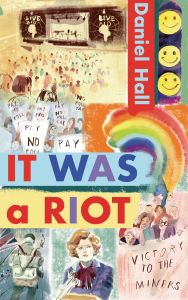
Review: It Was A Riot by Daniel Hall

Synopsis:

Growing up gay in the violent and poverty-stricken streets of East London, Eddy’s childhood is haunted by the shadow of bullying, rejection, and his domineering football hooligan father. Enrolling in medical school is his only lifeline – but it only catapults him into a fresh set of struggles that will define the rest of his life.

From the brutal front lines of the Falklands War to the impoverished mining communities of Northern England and the drug-fuelled raves of London, Eddy desperately tries to numb his pain and escape his inner demons. But his efforts are futile – and with the spectre of AIDS hanging over his head, he’s helpless to prevent his closest friends from succumbing to the disease.

But Eddy can’t hide forever. After a protest turns violent, he’s left fighting for his freedom against a biased court system that’s hell-bent on jailing him for manslaughter. His story quickly ignites a national frenzy as his case hits the headlines. And when Eddy makes a shocking discovery about his past, he must re-evaluate his entire life and decide what’s really important.

Can Eddy escape the shadow of his father’s judgement? Or will he never be able to accept himself for who he is?

As a gripping and authentic contemporary LGBT fiction novel that explores the stark realities of being gay in 1990’s England, It Was a Riot explores deep themes of identity, sexuality, paternal rejection, and the struggle to find oneself. This book is a must-read for fans of character-driven epics including Tomasz Jedrowski’s Swimming in the Dark and Douglas Stuart’s Shuggie Bain. Scroll up and grab your copy today.

Favorite Lines:

“And when I’m not being honest with myself, it also means I’m not living the life I really want.”

“You’ll always make me proud… No matter what you do. No matter the path you choose in life. No matter what you do or don’t accomplish. I’ll always be proud of you.”

My Opinion:

I received a copy of this book from the author in exchange for my honest opinion.

This story follows Eddy, who grows up in England in the 1990s with a complicated childhood. Eddy is gentle and kind but his father demands that he learns how to be a “real man” so Eddy signs up for boxing classes and learns how to fight. Despite this attempt to please his father, Eddy comes to the realization that he is just not a violent man and finds his real passion is in the medical field so he decides to go to medical school. After gradating, Eddy joins the military to get more training as a doctor and it is here that he realizes that he is gay.

As the story evolves, we follow Eddy as he tries to come to terms with his sexuality and begins to explore the world as a gay man. While there is some joy in this exploration, it isn’t all rainbows and sunshine. Eddy faces a lot of hard truths from both the outside world but also from within himself. As Eddy finally begins to find some real peace, his past comes back to haunt him and he finds himself in court fighting for his freedom.

This is a debut novel for Hall and it exceeded all of my expectations. It pulled me in from the first chapter and had me engaged throughout the story until I realized I had finished it in one sitting. Hall tells a beautiful and heartbreaking story that is simultaneously devastating and important to read. This touches on learning to live outside of your parents’ shadow, the prejudices that the LGBTIQA+ community faced, and learning to be at peace with your own identity. But be warned, you’ll be crying by the end!

Summary:

Overall, if you are interested in coming of age fictional stories with strong character development involving LGBTIQA+ and the gay community during the AID’s epidemic, then this book could be for you. Happy reading!

Check out It Was a Riot here!


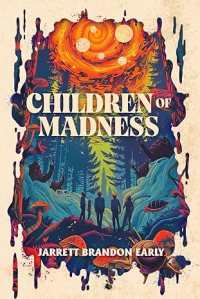
Children of Madness by Jarrett Brandon Early

Synopsis:

FOR A WORLD GONE CRAZY, ONLY THOSE RAISED AMONG MADNESS CAN HELP

The Imperator of Quaan restlessly awaits the centennial arrival of the Snail-Gods to cure the Gloomtide, a shadow of melancholy blanketing the Titian Empire. But when the Supreme Helices finally make landfall, they do so just out of reach of the distressed monarch, beyond a poisonous grove that separates man from messiah.

Fincher Bugg leads the Sour Flower Gang, the preeminent child harvesters of the Stenches, a town of outcasts condemned to diminished lives toiling away in toxic conditions. As Fincher and his four friends endure external abuse from outsiders, internally they also suffer, watching as their parents slowly succumb to the Maddening. Despite the solace of unbreakable friendship, life is unrelenting.

When a desperate king makes a seemingly magnanimous offer to a hopeless population, the Sour Flower Gang sets out on a harrowing expedition to find God for the very people who cast them aside.

During a journey in which the children encounter the unimaginable—both beautiful and nightmarish—a terrifying question takes shape. Are the Snail-Gods here to once more save mankind, or is the Gloomtide that has enveloped Quaan a precursor to humanity’s deserved end?

Favorite Lines:

“Ash’s heart jumped again. She blamed it on the exertion of the pull.”

“Good. You have each other. That’s more than most in this cursed land. Do not take that for granted. Together,  you can move worlds.”

“I know that they’re carnivores. But as to what kind of carni they vore, I have no idea.”

My Opinion:

I received a copy of this book from the author in exchange for my honest opinion.

One thing that I love about fantasy is that you can pretty much think up whatever you want. There are no rules to follow and your creativity is not bound to the laws of our every day world. The story that Early weaves in Children of Madness is just one example of this. This story follows Fincher Bugg and his friends as they set foot on a journey on behalf of the ruler of Quaan who is desperate to reach what is supposed to be the answer for humankinds survival – the Snail-Gods.

This book was a journey in itself. Early creates an utterly unique world unlike anything I have ever read before that is still somehow believable. While there are themes that run parallel to what we see in our every day lives in reality, Early scatters them throughout this story in a creative and refreshing way. I wasn’t expecting this to be a coming of age-esque story but it still pulled in that direction to me; perhaps it was the constant theme of friendship throughout.

I did find that while this book is quite long, I never really felt like it was a chore to read. Each chapter had good pacing and I found myself somehow wanting more by the end of the book. I also appreciated the map at the beginning to keep my bearings throughout the journey.

Summary:

Overall, if you like epic fantasy full of action, adventure, suspense, friendship, and some mystery then this book could be for you. Happy reading!

Check out Children of Madness here!


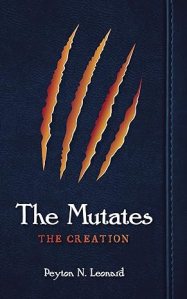
Review: The Mutates: The Creation by Peyton N. Leonard

Synopsis:

What would you do if your humanity was brutally stolen from you? How far would you go to reclaim that humanity? Tyler, Samy, Andy, and Lola are just a bunch of teenagers living in Ellwood City, Pennsylvania in 2009 when they are kidnapped and experimented on, becoming genetically modified feline humanoids with wings, called Mutates. They struggle to make sense of their mutations and fight for their freedom and humanity all the while growing their bonds with one another and the people they come across. Their journey is fraught with adversity, heartache, and pain, but they learn to overcome their challenges and become even stronger individuals in the process. Come and join Tyler, Samy, Andy, and Lola as they embark on the ride of their lives.

Favorite Lines:

“No matter what I said to her, she was always smiling and taking everything in stride. She’d been like that ever since she was born. Legend has it that she’s smiling at this exact moment.”

My Opinion:

I received a copy of this book from the author in exchange for my honest opinion.

This story follows a group of teenagers who, at the start of the story, think their biggest issue is surviving high school. They’re quickly proven wrong when they are kidnapped and turned into Mutates; genetically modified humanoids with feline features and wings. Readers are along for the ride as they come to terms with their situation and fight for their freedom.

It has been quite some time since I have read a true young adult  book. I forgot how different the author’s voice can be through a YA story versus something like NA. This story is told from the PoV of the kids/teenagers and really immerses you in the story because of the tone. I will admit that the PoV changes were a bit confusing to me but also added dimension to the story.

I do think that the transformation process to Mutates happened really fast. One minute they are just human and the next they are more. I wish there had been more detail as it was a bit of a whirlwind. I did like the epilogue. Without giving anything away, it wraps everything up with the beginning of the story and I thought it was very creative.

Summary:

Overall, this was an enjoyable and creative book. It reminded me of Percy Jackson meets Maximum Ride. If you like young adult, romance, action, adventure, friendship, and hints of religion/spirituality in your books than this one might be for you. Happy reading!

The Mutates: The Creation