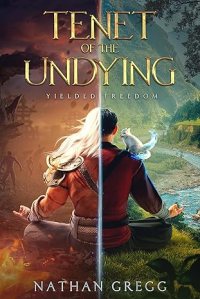
Synopsis:
Fight. Win. Die. Repeat.
That summed up Ren’s life. Or rather, both lives.
After dying a veteran in a dead land, Ren’s soul is snatched up by a Goddess to be her pet warrior. But despite every bloody assignment, Ren won’t die. His new master yanks his soul from the jaws of death each time, his second chance at life now a blur of pain and service without end.
Until his moment to escape finally comes, to a place not even she can find.
But this new world is strange. They have magic here. Their culture is utterly foreign, just as foreign as Ren is to them. In a world ruled by sects and cultivators and mana arts, might makes right. Only the strong survive.
Good thing that’s what Ren does best.
Ren’s found his freedom, and he intends to keep it at all costs. Even if he must yield some of it to yet another master… and understand a strange new power before it kills him a final time.
The Goddess’ dog is off his leash and sharpening his fangs.
Favorite Lines:
“The world had ended regardless of their struggles, after all. But that didn’t seem right.”
“Worn, but not broken. Tired, but still willing to fight”
“A man is not defeated until he considers himself to be.”
My Opinion:
I received a copy of this book from the author in exchange for my honest opinion.
Tenet of the Undying: Yielded Freedom is a brutal, emotionally charged fantasy that never lets the reader forget the cost of survival. From the opening chapters, it’s clear this is not a story interested in clean victories or heroic simplicity. Instead, it follows Ren through cycles of violence, endurance, and moral erosion, asking what freedom actually means when it must be earned through endless suffering. The tone is unflinching, often grim, but it never feels gratuitous. Pain here has purpose, even when it’s overwhelming.
Ren is a compelling protagonist precisely because he is worn down. He is powerful, but never invulnerable. His strength is counterbalanced by exhaustion, grief, and an accumulating sense of responsibility for those who die alongside him. The arena, the cultivators, the monsters, and the larger cosmic forces all blur together into a system that feeds on struggle. What stood out to me is how often Ren’s internal conflict mirrors the external one. Every fight pushes him forward physically while pulling him apart mentally, especially as his tenet awakens and demands something from him that he doesn’t fully understand.
The relationship between Ren and old man Ren is the emotional backbone of the book. Their dynamic is layered with mentorship, manipulation, love, resentment, and inevitability. It’s clear that everything Ren is becoming was shaped deliberately, and that realization lands heavily. The book handles this relationship with patience, allowing its full weight to unfold over time rather than relying on a single revelatory moment. The result is a quiet devastation that lingers long after the scenes themselves end.
Worldbuilding in Tenet of the Undying: Yielded Freedom is expansive but never detached from the characters living inside it. Cultivation levels, cosmic entities, and apocalyptic stakes are filtered through individual loss and memory. Even when the scale becomes immense, the narrative keeps returning to bodies, wounds, fear, and choice. By the later sections, the story feels less about winning and more about enduring without losing one’s humanity entirely.
What stayed with me most is how the book treats freedom not as a reward, but as a burden. Freedom is something Ren is promised, fights for, and ultimately questions. The novel refuses to present liberation as an endpoint. Instead, it frames it as a responsibility that can destroy you if you’re not prepared to carry it. That tension gives the book its emotional gravity and sets it apart from more conventional progression fantasy.
Summary:
Overall, Tenet of the Undying: Yielded Freedom is a dark, emotionally intense fantasy that blends cultivation, cosmic horror, and character-driven tragedy. It will resonate most with readers who enjoy grim fantasy, progression fantasy with consequences, and stories that interrogate power, sacrifice, and freedom rather than celebrating them outright. This is a book for readers who want depth alongside action, and who are comfortable sitting with discomfort long after the final chapter. Happy reading!
Check out Tenet of the Undying: Yielded Freedom here!

 Likely Story