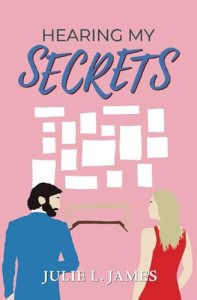
Review: Hearing My Secrets by Julie L. James

Synopsis:

At first glance, Marion Andrews would seem to have it all. She’s just been promoted at her job at the top home design magazine where she’s worked for a few years on the creative team, and she’s earned it, even after a few blunders. Her personality and work ethic have taken her far, but not everything is as it seems in her personal life.

Marion’s been hiding her biggest insecurity for years, and now that she’s working closer with her handsome and austere boss, Mr. Shaler, she’s never felt more unsure about whether or not she should reveal it. Mr. Shaler isn’t as intimidating as Marion thought and she never expected things between them to be quite so friendly.

During her transition in her new position, she meets Charlie, a stranger who insinuates he knows things about her past. Charlie keeps popping up in her life, revealing more each time, and getting closer to Marion in every way.

Caught between her tragic past and her dramatic present life, Marion realizes she doesn’t have control over everything and has to find a way to navigate how she can “have it all” without the unforeseen drama that comes with it.

Favorite Lines:

“Gratitude is always the best attitude.”

“‘What do you have against hot drinks?’ I asked. ‘The concept of soaking ground bits of vegetation in boiling hot water feels wrong to me,’ he explained.”

“I moved closer, resting my head on his chest, hearing his heart beneath me, and appreciating the sound of every single beat.”

My Opinion:

I received a copy of this book from the author in exchange for my honest opinion.

Julie L. James’s Hearing My Secrets is a heartfelt and quietly powerful novel that blends workplace drama, hidden disabilities, and unexpected romance into something utterly engaging. From the opening pages, we’re drawn into Marion’s world—a young editorial assistant at a glossy home design magazine who is trying to keep a tightly held secret: she wears hearing aids.

The strength of this book lies in its honesty. James doesn’t sugarcoat Marion’s insecurities, frustrations, or her deep desire to be seen for her talent, not her limitations. The writing is warm, often funny, and steeped in the little textures of life—fabric swatches, late-night train rides, whispered lobby secrets. There’s something incredibly comforting in how ordinary everything feels, even as major emotional shifts are happening.

The story evolves gently, but not without stakes. Between a blossoming workplace crush, office politics, and glimpses into Marion’s painful childhood accident, Hearing My Secrets keeps you hooked with emotional resonance rather than high drama. And when romance sparks, it’s the kind that feels earned—tender, tentative, and full of chemistry.

It’s rare to find a novel that explores disability, ambition, and love with this much grace. This is a quiet triumph of a story—one that champions sensitivity without sentimentality, and strength without loud declarations. You’ll be rooting for Marion from the first page to the last.

Summary:

Overall,  this book is full of warmth, wit, and an eye for every day beauty. It offers a slow-burning romance wrapped in emotional honesty, making it a refreshingly grounded and relatable read. If you like romance with a splash of comedy, then this book could be for you. Happy reading!

Check out Hearing My Secrets here!


Review: The Regression Strain by Kevin Hwang

Synopsis:

Nobody’s safe when the inner beast awakens…

Dr. Peter Palma joins the medical team of the Paradise to treat passengers for minor ailments as the cruise ship sails across the Atlantic. But he soon discovers that something foul is festering under the veneer of leisure. Deep in the bowels of the ship, a vile affliction pits loved ones against each other and shatters the bonds of civil society. The brig fills with felons, the morgue with bodies, and the vacation becomes a nightmare.

One by one, the chaos claims Peter’s allies. His mentor spirals into madness and the security chief fights a losing battle against anarchy. No help comes from the captain, who has an ego bigger than the ocean.

With the ship racing toward an unprepared New York, the fate of humanity hinges on Peter’s deteriorating judgment. But he’s hallucinating and delirious…and sometimes primal urges are impossible to resist.

The Regression Strain is a fast-paced medical thriller laced with psychological suspense, perfect for fans of Michael Crichton and Blake Crouch.

Favorite Lines:

“Right back into it, then. He was a kid on a roller coaster cresting the first big incline—the moment before the bottom fell out. He opened the closet and confronted his uniform. Sure, he’d paid for the ride, but that didn’t make it any less stomach-churning.”

“Funny how standards eroded in the face of devastation.”

“The holes in his memory were filling in like groundwater welling up in the paw prints of a rabid raccoon. Muddy and random.”

My Opinion:

I received a copy of this book from the author in exchange for my honest opinion.

What starts as a slow simmer quickly boils over in The Regression Strain, Kevin Hwang’s debut that’s equal parts medical mystery, psychological spiral, and pandemic-era existential horror. It’s not a long book, but it’s the kind that lingers—creeping into your thoughts days after you’ve closed it.

The story follows Dr. Peter Palma caught in the chaos of a rapidly spreading fungal pandemic. But Hwang doesn’t just want to tell a virus-outbreak story. He wants to pick at your nerves. The plot slips between sanity, and reality in a way that’s deliberately disorienting. Think fever dream with a med school vocabulary. And I mean that as a compliment.

What makes this novel hum is the way Hwang blends scientific precision with narrative messiness. There’s an almost surgical attention to detail in the clinical scenes—no surprise, given Hwang’s background in medicine—but it never feels like a lecture. Instead, the book immerses you in the  high-stakes environment of a cruise ship in the midst of a mysterious illness, only to pull the rug out with unsettling shifts in tone and perception. At times, I questioned whether what I was reading was happening at all—much like the narrator himself. It’s a risky move, but it works.

Stylistically, it won’t be for everyone. The prose can be clipped and clinical one moment, then rush into sensory overload the next. It’s intentional and immersive, but it can make for a slightly uneven reading experience. That said, if you’re the kind of reader who doesn’t mind being dropped into the deep end—without floaties—there’s a lot to appreciate here.

Emotionally, The Regression Strain taps into something very now. The anxiety of being overeducated but powerless. The loneliness of a pandemic. The slow erosion of certainty. It’s not a comforting read, but it’s a relatable one, especially if you’ve ever tried to logic your way through a crisis and come out the other side more confused than when you started.

Summary:

Overall, is it horror? Sci-fi? Psychological drama? Honestly, it’s all of the above and then some. Hwang doesn’t seem interested in coloring within genre lines, and that’s part of the fun. The Regression Strain is sharp, strange, and surprisingly affecting. It’s not your typical outbreak story—It’s weirder (in a good way), smarter, and a bit sadder.

Can we also take a minute to acknowledge that Hwang is a whole father and doctor and still somehow found time to write this masterpiece, I am in awe! If you like horror, suspense, action, medical mysteries, sci-fi, and/or thrillers then this book could be for you. Happy reading!

Check out The Regression Strain here!


Review: Coven of Andromeda by Ron Blacksmith

Synopsis:

When a powerful magical artifact disappears from the Tanner home, Bree uncovers her family’s true legacy: they’re descendants of witches who fled a dying world centuries ago. Now, Bree must forge an uneasy alliance with Sam Sorken, her mysterious neighbor who harbors secrets of his own—he’s a necromancer from that same world, sworn to protect the coven.

Together, they race against time to stop Kestral Drach, a vengeful voodoo witch preparing to breach the Realm of the Dead and consume the power of countless spirits. As ancient histories collide with present dangers, Bree must embrace her heritage and master unexpected magic that binds her family across generations, before Kestral unleashes forces that could destroy both worlds.

Favorite Lines:

“The timing of destiny is rarely convenient”

“Balance has never been particularly difficult to disrupt.”

“Different paths sometimes lead to the same destination, my boy.”

My Opinion:

I received a copy of this book from the author in exchange for my honest opinion.

At first glance The Coven of Andromeda looks like two different novels stitched together: a high-fantasy apprenticeship set beneath lavender skies on Eldoria, and a contemporary tale of bayou folk-magic unfolding in rural Louisiana. The stitching, however, is deliberate. As dimensional rifts widen, necropolis spirits seep into southern swampland, and the narrative threads converge with satisfying inevitability.

Blacksmith frames the entire story around one idea—that so-called “life-magic” and “death-magic” are complementary halves of the same discipline . Sameril, a meticulous student of necromancy, and Bree Tanner, a reluctant heir to her grandmother’s coven, spend much of the book wrestling with that paradox. Their eventual alliance is persuasive because both characters must confront inherited duty: Sameril through the austere Codex Mortis , Bree through a family legacy that offers “truths we must face” rather than evade .

Structurally, the novel alternates measured training chapters with brisk set-piece battles; the rhythm reminds me of a well-paced anime season. The climax is undeniably crowded—multiple factions, a power-hungry voodoo queen, and a spirit of chaos invoked in a single ritual—but the ambition rarely tips into confusion. When the rifts finally erupt, Blacksmith delivers the promised spectacle without abandoning the quieter question of what balance between worlds should look like.

Stylistically, the writing alternates between lyrical description and colloquial banter. A paragraph detailing obsidian pillars flickering with ghost-light may be followed by a dry aside about who is responsible for bringing refreshments to the next ritual. This tonal flexibility works because the characters themselves embrace both gravity and levity; a sisterly bond forged late in the novel underscores that the real stakes are personal before they are cosmic .

Summary:

Overall, I would describe this as A Darker Share of Magic colliding with Practical Magic at a Cajun cookout. Readers who enjoy expansive fantasy with contemporary texture will find The Coven of Andromeda an engaging—and occasionally demanding—journey. Its length requires patience, but the reward is a robust exploration of power, responsibility, and the fragile equilibrium between the realms of the living and the dead. Happy reading!

Check out Coven of Andromeda here!


Review: ลูกครึ่ง: Only Half a Person by Rowland Grover

Synopsis:

When Rowland Grover asked his preschool teacher if he could ฉี่ (chi), she looked at him like he wasn’t speaking English. After holding it for too long, he peed his pants and realized he was different from everyone around him.

As a half-Thai/half-white kid raised Mormon in Idaho, shame, guilt, and confusion were normal for Rowland. He didn’t understand why he took off his shoes at his house, but his friends could keep theirs on and drag dog poop all over the floor. When Rowland lived in Thailand, Thai people said he looked farang, but white people called him Mexican. This made him wonder who he was and where he belonged.

ลูกครึ่ง: Only Half a Person is an captivating and hilarious collection of essays and short stories that explores culture, faith, and identity. The stories range from “stinky lunches” to a talking lizard questioning Rowland’s religion. Others are more serious such as when a stranger called the cops because Rowland looked threatening riding an old beach cruiser bike. Tackled with humor and heart, Rowland dives into the depths to find himself and wonders if he’ll come up for air.

Favorite Lines:

 “You don’t see me calling out ‘white customer’ to get your attention, do you?”

“Our foods aren’t weird. Our cultures aren’t weird. Our people aren’t weird.”

 “I share my story so people can be aware of what others face.”

My Opinion:

I received a copy of this book in exchange for my honest opinion.

Rowland Grover’s ลูกครึ่ง — Only Half a Person feels less like a polished memoir and more like an afternoon swapping stories with a friend who finally trusts you enough to laugh at the worst parts. It kicks off with a preschool mishap in rural Idaho—one short misunderstanding, one very damp pair of pants—and the sudden realization that nobody around him speaks the mix of Thai and English rattling in his head. That flash of embarrassment becomes the thread he keeps tugging for the rest of the book.

Each chapter lands like a quick comedy bit that refuses to fade to black. Grover bounces from teachers butchering his mum’s Thai name to a fast-food customer who labels every brown worker “Mexican” and to a missionary buddy daring him to chew kaffir-lime leaves just to watch him squirm. The punch lines are tight, but they always swing back and nick something tender—pride, doubt, the weird ache of feeling both inside and outside at the same time.

Halfway through, the jokes stretch into essays and open letters. A riff on “authentic” pad thai turns into a quiet rebuke of people who gate-keep culture; another piece answers a reader who calls Asian food “weird,” and the patience in that reply is razor-thin. By the time Grover writes a mock cease-and-desist to his future haters, the laughs carry a distinct after-taste of anger and relief—like finally exhaling after holding it far too long. The real hook, though, is his voice. Grover flips between English, transliterated Thai, and full Thai script without italicizing or apologizing. The code-switching isn’t there for flair; it’s there because that’s simply how his thoughts land on the page. Reading it feels a bit like being handed earbuds and invited into the soundtrack of his brain—off-beat, bilingual, and impossible to file under one neat label.

Summary:

Overall, short, sharp, and genuinely funny, ลูกครึ่ง — Only Half a Person reminds us that identity isn’t a puzzle you solve once—it’s a joke you keep rewriting until it stops hurting. If you’ve ever lived in the hyphen or asked someone to explain theirs, this one’s worth an afternoon. Happy reading!

Check out ลูกครึ่ง — Only Half a Person here!


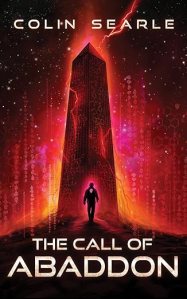
Review: The Call of Abaddon by Colin Searle

Synopsis:

To save the human race from the ultimate cosmic threat, Jason will have to become something far beyond human.

New Toronto is a fractured city-arcology on a dying Earth, where hope is as scarce as clean air. For Jason, survival means scavenging the ruins beneath the city – where any day could be his last.

But everything changes when an ancient alien obelisk – the ABADDON BEACON – attacks Jason’s mind from afar, making his dormant psychic abilities spiral out of control. After barely surviving Abaddon’s psionic possession attempt, Jason and his companions are left with no choice but to find the obelisk before it consumes him.

Problem is, Abaddon has been sealed within a top-secret United Earth Federation research lab for over a century, silently worming its alien technologies into human society, presented as gifts with a far darker purpose. The Beacon doesn’t just speak; it infects, projecting its viral energies far beyond the walls of the lab.

And Jason isn’t the only one hearing Abaddon’s call. Across the Solar System, a ruthless Emperor will stop at nothing to seize the Beacon’s power for himself.

As the Imperial invasion of Earth looms, Jason’s quest to confront Abaddon will force him into a critical choice: master the strange power growing inside him…or succumb to the

Beacon’s godlike influence, ushering in mankind’s doom.

The Call of Abaddon is a gripping mythological tale of humanity’s struggle to overcome an unimaginable darkness, blending the political intrigue of Dune with the eldritch terror of Lovecraft, and the explosive world-building of The Expanse.

Favorite Lines:

“‘Sounds wonderful,’ Sam responded, oozing sarcasm. ‘Now, enough stalling—let’s go find the yoks and that stupid-ass robot'”

“Aren’t you glad you got involved with us crack Undocs…?”

“Right now, we don’t have time to get into that, and frankly, there’s some things about myself that I don’t make a habit of discussing.”

My Opinion:

I received a copy of this book from the author in exchange for my honest opinion.

The Call of Abaddon drops us straight into neon-soaked New Toronto, where ex-street kid Jason and his salvage crew comb a rotting megacity for half-functional nanotech. By page three, malfunctioning bots are sparking, black-market implants are changing hands, and a strange psychic signal is tunneling into Jason’s head, promising trouble if he dares ignore it.

The spine of the novel is Jason’s unwanted link to the Abaddon Beacon—an ancient obelisk that hijacks his dreams and starts rewriting the very tech he lives on. Colin Searle layers that creeping dread over kinetic salvage runs and under-city gunfights, all while a self-replicating nanite “Phage” looms in the background, ready to turn yesterday’s gadgets into tomorrow’s monsters.

What keeps the grimness from swallowing the book is the crew’s banter. Their gallows humor and sibling snark feel lived-in, grounding the high-concept horror in recognizably human friction. When reactor seals fail or a rust-bucket drone opens fire, the arguments feel like the kinds you’d have with friends while racing to plug a leak.

Scope-creep is the one snag: the action rockets from claustrophobic tunnels to full-blown interplanetary war. A late exposition dump about the Solar Empire’s crusade opens the universe but also stalls the momentum just long enough to notice. Even so, Searle’s knack for crunchy tech and apocalyptic imagery keeps the pages—and the debris—flying.

Summary:

Overall, grim, punchy, and weirdly heartfelt, The Call of Abaddon serves up cyber-ruins, cosmic horror, and a found-family you’ll root for right up until the Beacon calls their names. Happy reading!

Check out The Call of Abaddon here!


Review: MATE: A Novel in Twenty Games by Robert Castle

Synopsis:

MATE: a novel in twenty games deals with marriage as a chess game. What distinguishes MATE from other stories and novels about the life and death of a relationship is its radical correlation of the actions of a husband and wife to chess moves. The logic of the novel suggests: chess is war reduced to a game; marriage is chess; marriage is war. That is the tragedy—marriage, as a human institution and human desire, is innately tragic. In marriage, one or the other partner feel obliged to annihilate the other in a struggle for…what? This is the central question and riddle of MATE.

Favorite Lines:

“Psychological brutality alone would have satisfied the patrons of the Roman Colosseum.”

“This is tragedy of the modern game, the games cannot avoid desperate attempts to defeat one’s opponent.”

My Opinion:

I received a copy of this book from the author in exchange for my honest opinion.

MATE: A Novel in Twenty Games imagines marriage as a grand-master tournament, complete with opening gambits, trash-talking color commentary, and a running scoreboard that rewards the first spouse to notch six wins. Robert Castle’s conceit lands fast: every domestic flare-up—whether it’s bedtime negotiations or political chatter over lamb chops—gets diagrammed like a tactical skirmish. The result is part sports broadcast, part relationship post-mortem, and entirely compulsive to read.

Most chapters replay a single “game.” Castle’s unseen narrator calls the moves with gleeful precision, pausing to highlight blunders and propose sharper sidelines the players never see. A simple grocery-store run, for instance, spirals into feints, sacrifices, and counter-punches that would impress a blitz champion. The play-by-play can be savage, but its real charm is how it exposes tiny hurts we all recognize—the sigh before an argument, the silent tally of old grievances—without ever dropping the tournament mask.

Beneath the quick wit sits a bleak observation: perfectly played matches end in stalemate, and no clever tactic erases the cost of constant competition. Scores swing wildly—one chapter leaves Pillsbury a single victory from clinching the match—yet triumph feels hollow when the commentary reminds us another round always looms. Class anxiety, gender scripts, and ‘90s pop politics all take turns on the board, their influence measured in incremental positional gains rather than sweeping mates.

If there’s a hurdle, it’s overload. Castle peppers every game with alternative lines and psychological footnotes; the barrage can feel like reading an annotated grand-master classic without diagrams. Still, that density is the punchline: marriage, he suggests, is endless analysis paralysis, where the move you regret is always the one you just made.

Summary:

Overall, sharp, exhausting, and wickedly funny, MATE argues that when love turns into a tournament, the best most of us can hope for is a well-fought draw—and maybe a laugh at the post-game press conference. Happy reading!

Check out MATE: A Novel in Twenty Games here!